Demystifying genomics in cancer care

Cancer is a disease of the genome, caused by unchecked cell growth due to mutations or changes in our DNA. Cancer genomics involves studying the genetic changes in cancer cells, allowing us greater insight into prevention, early detection, treatment, prognosis and recurrence.

In the case of cancer, a change is introduced which causes the cells to multiply uncontrollably – they become cancer cells and allow a cancer to develop. Most of the time these cancer-causing genetic changes are acquired i.e. they occur from damage to genes in a particular cell during a person’s life (also known as sporadic cancer). 

Why does cancer run in families?

Around 5-10% of cancers are caused by inherited or germline changes. This is where a genetic alteration occurs in a sperm or egg cell. It passes from the parent to the child at the time of conception and the alteration in the initial egg or sperm cell is copied into every cell within the body.

As the genetic alteration affects reproductive cells it can pass from parent to child and onwards to subsequent generations. Conditions such as Lynch Syndrome, is an example of an inherited cancer syndrome. This dominantly inherited conditions can greatly increase an individuals risk of developing cancer and mean that there is a 50% (or 1 in 2) chance that a parent can pass the genetic alteration onto their child.

Identifying a person with an inherited form of cancer is important. It means they can be looked after more closely in the future but it also has important implications for the family.

Genomics allows us to develop more precise treatments for cancer. Targeting treatments that focus on a cancer’s genetic makeup rather than where it has grown in the body.

https://www.macmillan.org.uk/healthcare-professionals/news-and-resources/blogs/demystifying-genomics-in-cancer-care

Cancer Prevention Recommendations

“Our Cancer Prevention Recommendations are the conclusions of an independent panel of experts – they represent a package of healthy lifestyle choices which, together, can make an enormous impact on people’s likelihood of developing cancer and other non-communicable diseases over their lifetimes.”

Lynch syndrome prediction model

The PREMM5 model is a clinical prediction algorithm that estimates the cumulative probability of an individual carrying a germline mutation in the MLH1, MSH2, MSH6, PMS2, or EPCAM genes. Mutations in these genes cause Lynch syndrome, an inherited cancer predisposition syndrome.

N.B.:This website is provided for informational purposes only. The content is not intended as a substitute for professional medical advice, diagnosis, or treatment. Always seek the advice of your doctor or other qualified health provider with any questions you may have regarding your personal health or medical condition.

https://premm.dfci.harvard.edu

HSE an organisation that requires serious change?

Interview with new CEO of the HSE

Requires a hands on approach….

Process by which decisions are made…

People closer to the point of decision making…

Accountability for decision makers…

A service we all have confidence in….

Personal ownership…

IT system improvements in the shorter term….

https://www.rte.ie/radio/radio1/clips/22222323/

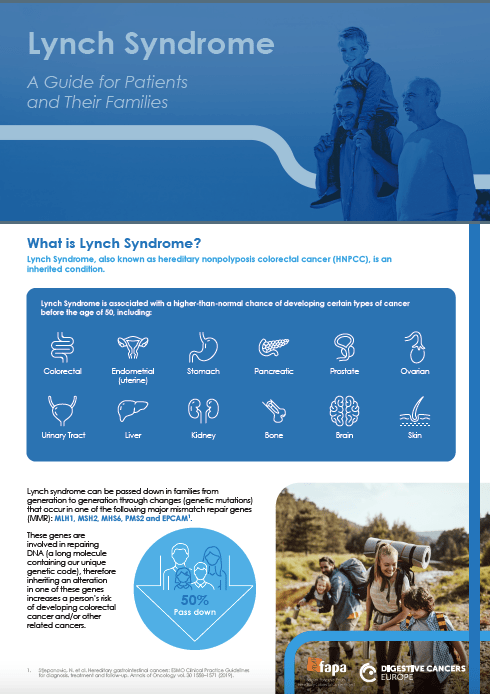
 Lynch Syndrome 

A Guide for Patients and Their Families 

 Lynch Syndrome is associated with a higher-than-normal chance of developing certain types of cancer before the age of 50.

What does it mean to live with Lynch Syndrome? 

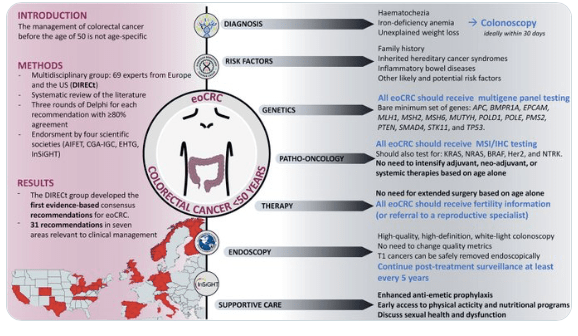
Delphi Initiative for Early-Onset Colorectal Cancer (DIRECt) International Management Guidelines

Conclusions

The DIRECt group produced the first consensus recommendations on eoCRC. All statements should be considered together with the accompanying comments and literature reviews. We highlighted areas where research should be prioritized. These guidelines represent a useful tool for clinicians caring for patients with eoCRC.

Results

The DIRECt consensus produced 31 recommendations for patients diagnosed with eoCRC ≥18 years old based on 145 articles (summarized in Supplementary Appendices 2–7). When appropriate, issues related to colon or rectal cancers specifically are highlighted; in cases where statements applied to both colon and rectal cancer, the term colorectal cancer (CRC) was used.

All statements are summarized in Table 2Table 3Table 4(Table 2: diagnosis, risk factors, and genetics; Table 3: pathology, oncology; Table 4: endoscopic diagnosis and treatment, therapy, and supportive care). Areas of controversy are described throughout the main text and summarized in Table 5.

http://ow.ly/ugCX50N1g1L

Does Genetic Testing Affect The Cost of Life Insurance in Ireland?

Well, fortunately for you, if you have undergone genetic testing, they don’t, and they can’t add a loading to your policy.

Why can’t insurers use genetic test results?

We all have the Disability Act 2005 to thank.

This pretty sound piece of legislation prohibits the insurance companies from asking about genetic tests.

When you apply for life insurance, you must disclose a certain amount of personal information, such as:

  • Family medical history
  • Personal medical history – Your insurer may ask for access to your medical records, but you have to provide your permission for this.
  • Your age
  • Height & weight
  • Whether you are a smoker or a drinker
  • Any prescription drugs you take
  • Your occupation – high-risk occupations can increase your premiums)
  • Any hazardous hobbies you take part in
  • Star sign
  • Pet’s name
  • Mother maiden name
  • How many photos contain traffic lights

Can You Get Life Insurance After Cancer?

Yes, it is possible to get life insurance after a cancer diagnosis. However, the availability and terms of coverage will depend on the specific details of your diagnosis, treatment, current health status and family history.

There’s no getting around the fact that life insurance after cancer is more expensive. If you can get cover, the insurer will increase your premium significantly compared to someone with no history of health issues.

Normally this increase will be temporary for a period of between one to ten years.

Immunotherapy and… Nothing Else? Studies Test Potential Paradigm Shift in Cancer Treatment

The leaders of those trials and other experts stressed that much more research is needed before this treatment approach becomes part of everyday cancer care. But they agreed that the findings so far are highly encouraging.

The most recent results come from a 35-patient clinical trial conducted at MD Anderson Cancer Center. Most patients in the trial had locally advanced colorectal cancer. Perhaps most important, however, was that all participants’ tumors had specific genetic changes—known as MSI-high or dMMR—that make them particularly good candidates for immunotherapy.

Review of governance arrangements to support HSE drug reimbursement process

The Report concluded that there is scope for improvements in a number of areas, including:

  • transparency of the process
  • communications with, and the availability of, information to patients
  • tracking the progression of medicines through the process

The Minister for Health fully supports any recommendations contained in the Report that improve the process, provide easier access, and support value for money.

Speaking on the publication of the report, Derick Mitchell IPPOSI CEO stated that ‘although long overdue, the publication of this report is an important step in the reform of our medicines access process in Ireland.  The report findings are sensible and practical, and need consideration in the Irish context.  The fact that many other countries, including our near neighbours in Scotland, have many of these reforms already in place is a cause for concern for many patient groups’, he said.

IPPOSI looks forward to engaging with the new working group in 2023 as part of its consultation with patient groups.