
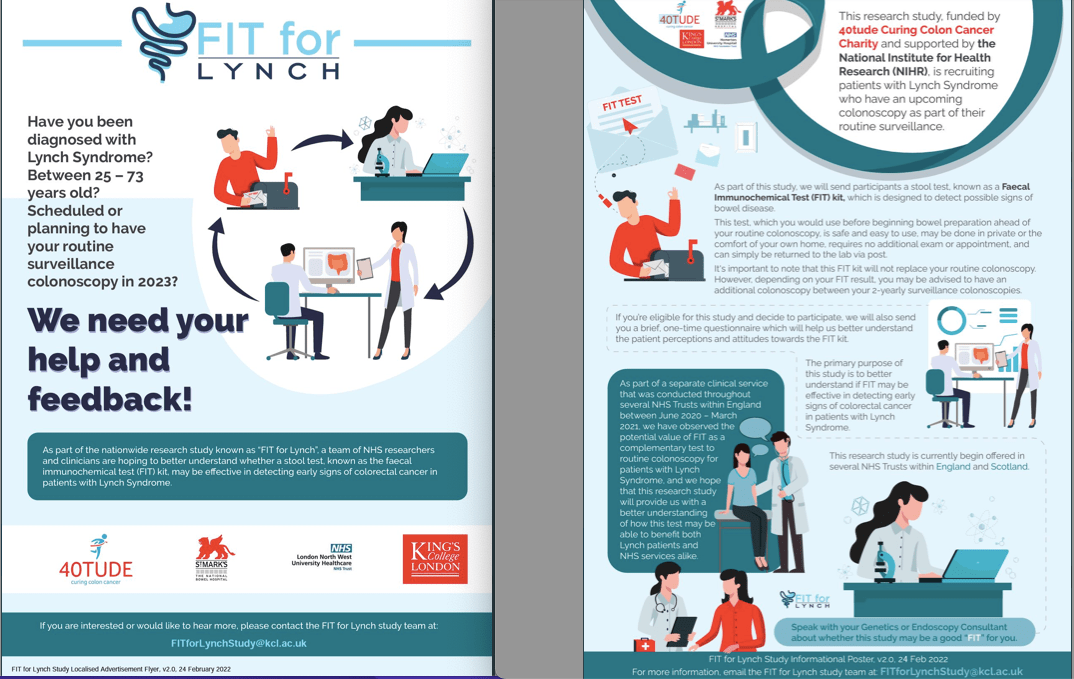
This research study is currently being offered in
several NHS Trusts within England and Scotland.
Contact: fitforlynchstudy@kcl.ac.uk
This research study is currently being offered in
several NHS Trusts within England and Scotland.
Contact: fitforlynchstudy@kcl.ac.uk
When you agree to genetic testing, you expect a yes or no answer: yes, you have an abnormal change in a gene that increases your cancer risk, or no, you don’t. But sometimes, you might not get a clear “yes” or “no.” You might just get a “maybe.”
Are genetic variants of uncertain significance common?
Almost 20% of genetic tests identify a VUS. These tests come in different “sizes.” Some examine only a handful of genes associated with cancer at a time, while others analyze up to 80 genes. The more genes you look at, the more variants of uncertain significance you’ll find.
https://www.mdanderson.org/prevention-screening/family-history/genetic-testing.html
Patient Information – 2019
A new Bill was recently brought before the Seanad will aim to ensure cancer survivors are not denied access to financial products like mortgage protection and insurance due to their medical history.
The Bill, which will seek to revise current legislation, outlines that a person seeking access to financial services will no longer have to declare a cancer diagnosis five years after finishing active treatment. The move is supported by the Irish Cancer Society.
RECOMMENDATIONS
Genomics be used in health care in a targeted way for the purpose of diagnosing and treating disease. It should not be used for aesthetic purposes.
Strong protections, and appropriate, adequate supports are put in place to assist individuals, especially individuals from vulnerable groups, in making informed decisions around genomic testing options during their journey towards a diagnosis.
Individuals are given the option either during or following the genomic testing consent process to share their genomic data for the purpose of supporting health research. The research should contribute towards better health outcomes for individuals or for society, and this contribution should be clearly detailed and explained during the consent process.
Members of the public who consent to share their genomic data to health research should not receive any financial reward or preferential treatment from the health system or from third parties, for example, medical cards or discounted premiums.
See full report here:
“If we can manage to have all these cancer diseases and to live with it, then we can handle reading about it.”
“In multiple studies, the majority of patients with experience of open notes report that reading their notes is very important for feeling in control of their care, remembering their care plan, and understanding why medications are prescribed. Patients report trusting their provider more, greater goal alignment, and teamwork. These benefits are reported most often among patients who are older, non-white, those with fewer years of formal education, or do not speak English at home. Older and chronically ill patients, in particular, appreciate the opportunity to share their notes with family and friend caregivers.”
The term ‘cancer survivor’ commonly refers to a person that has been diagnosed with cancer at any stage during their lifetime and includes those who are undergoing treatment and those that have recovered from the disease.
The advice contained in this book is for cancer survivors who have been advised by their medical team to follow a healthy eating diet.
This book is also suitable for survivors who have finished their medical treatment and have been told they are in remission (given the ‘all clear’) from their disease, or those who have recovered from the disease.
There is currently no reliable screening test for ovarian cancer. Unfortunately, most women with ovarian cancer are diagnosed with advanced-stage disease (Stage 3 or 4).
This is because the symptoms of ovarian cancer (particularly in the early stages) often are not acute or intense, and present vaguely. In most cases, ovarian cancer is not detected during routine pelvic exams, unless the doctor notes that the ovary is enlarged.
The sooner ovarian cancer is found and treated, the better a woman’s chance for recovery. It is important to know that early-stage symptoms are not silent – so women should be extra alert and watch out for early symptoms.
You’ve had a colonoscopy and now you start reading the report and grow a little worried seeing the word “polyps” in the text. Does that mean you definitely have colorectal cancer?
For starters, no. The vast majority of colorectal polyps are harmless growths that sprout on the lining of your colon or rectum. They’re pretty common, especially in adults age 45 or older.
But that doesn’t mean polyps should be ignored, says colorectal surgeon Rebecca Gunter, MD. Colorectal cancer begins in polyps, after all. Finding and removing those polyps decreases your risk of developing the disease.
So, what’s the difference among polyps, and are some more worrisome than others? Dr. Gunter explains.
The smaller the polyp, the less likely it is to be on the road to cancer, says Dr. Gunter. Polyps can range in size from the less-than-5-millimeter “diminutive” category to the over-30-millimeter “giants.”
To put those sizes in perspective, a diminutive polyp is about the size of a match head. Larger polyps can be almost as big as the average person’s thumb.
Studies show that few smaller polyps are cancerous. As polyps slowly grow, however, the cancer risk rises. It’s estimated that it takes about 10 years for cancer to form into a colorectal polyp.
Polyps come in three basic shapes, says Dr. Gunter. They are:
Doctors examine removed polyps under a microscope for a close-up look at their cells. The review is to determine levels of dysplasia, a term used to describe how cancerous polyps appear on a cellular level.
Polyps with signs of high-grade dysplasia have disorganized cells with a larger, darker center. These dysplastic cells often grow wildly, a sign that cancer may have been close to forming in the polyp.
Your healthcare provider may recommend a follow-up colonoscopy sooner than normal if they find polyps with high-grade dysplasia. “It’s a finding that warrants increased attention,” notes Dr. Gunter.
Polyps with cells that look only mildly abnormal are labeled as having low-grade dysplasia and are of less concern.
Adenomas are polyps made from tissue that looks like the usual lining of your colon but isn’t. There are three kinds of adenomas, which doctors can determine by looking under a microscope. The types are:
Serrated polyps look like saw teeth under the microscope. They’re subtle, pale and without much form, making them easier to overlook during a colonoscopy. About 25% of colon cancers come from serrated polyps.
The answer is simple: Yes.
Though not all polyps turn into cancer, all colorectal cancers start as polyps. Removal eliminates the threat posed by a polyp. Keeping up with your colonoscopies allows your doctors to do just that.
Colonoscopies are recommended for everyone starting at age 45, or earlier if you have higher risk factors such as a family history of colon cancer. (Stool tests also are an option to screen for colon cancer, but colonoscopies remain the recommended method.)
“The reality is that colon polyps are fairly common,” says Dr. Gunter. “The good news is that removing them decreases your risk of colorectal cancer. A colonoscopy is a safe and effective procedure that could be life-saving. Don’t delay getting it done.”
LYNKED IN is a free annual, one-day educational conference for individuals with Lynch syndrome, their families, and caregivers, hosted by the Lynch Syndrome Center within the Division of Cancer Genetics and Prevention at Dana-Farber Cancer Institute.
This conference provides attendees with updates on guidelines for screening and prevention, strategies for communicating with your family, and advances in the treatment of Lynch syndrome. The goal is to connect and empower Lynch syndrome families.
Register here:
https://redcap.partners.org/redcap/surveys/?s=P4CC3W9THRCXA9EH


 Lynch Syndrome Ireland