Life after cancer: Navigating survivorship and mental health

Cancer doesn’t just take over a person’s physical body, but their very life?

In short, when it comes to journeying through cancer care, there seems to have been prolific, yet strangely finite, consideration of that path, ceasing when it comes to post-treatment.

Screening and diagnosis to treatment and remission have been covered, but what about what happens after that?

What about cancer survivorship?

The good news is that a shift in the state of affairs is occurring.

https://pharmaphorum.com/deep-dive/life-after-cancer-navigating-survivorship-and-mental-health

Number of outpatients seen per consultant has fallen by nearly 30% since 2016

Consultant Medical Oncologist at University Hospital Galway commented on this article to Newstalk FM: https://irishtimes.com/health/2024/07/12/number-of-out-patients-seen-per-consultant-has-fallen-by-nearly-30-per-cent-since-2016/

I am surprised that it is only a 30% reduction. In medical oncology in Ireland, in general, there has never been a ‘waiting list’ to access a consultant opinion, public or private. Since I started my training, every new referral was pretty much automatically booked to the next OPD clinic, i.e. within a week of receiving the referral. That is still the case. 15 years ago, this meant that routinely, a consultant and 2-3 NCHDs would have a 3 hour clinic with 60-70 patients booked in. A patient with a “3pm appointment” would still be waiting to be seen at 8pm. There was little time to discuss the proposed cancer treatment and potential side-effects. The system was clearly understaffed for the volume of patients.

I have said before that one of the positive achievements over the past 10 years is the increase in consultant numbers. This has allowed more meaningful outpatient clinic interactions.

However: If the HSE hires a new consultant with the aim of improving patient care in this way, it should obviously be the case that secretarial support, clinical nurse specialist support, office space, outpatient space, dayward space supported by qualified staff nurses, HSCP support, (theatre space for surgeons), diagnostic and interventional radiology access, etc is also required, to enable improved patient care. In other areas of medicine or surgery, access to a consultant opinion might well be a constraint, in Oncology, the bottleneck is access to the service.


Metaphor

Illness as Metaphor, in her book Susan Sontag sets out to diagnose the problem with the way we think about illness.

Her discovery was not to focus on sickness itself, but the language surrounding disease – language that can, in her view, quite literally kill.

https://www.fringefest.com/festival/whats-on/illness-as-metaphor

Universal Germline Genetic Testing for Hereditary Cancer Syndromes in Patients With Solid Tumour Cancer(2022)

Historically, professional society guidelines have recommended limited genetic testing for hereditary cancer syndromes (HCS) to patients with cancer thought to be at highest risk for carrying pathogenic/likely pathogenic germline variants (PGVs) in a few selected genes.

Reasons for this approach were largely based on the high costs of testing, perceptions that HCS were rare in the general population, and a paucity of clinical utility.

Discussion of the current evidence that challenges these assumptions and supports the implementation of universal HCS testing among patients with solid tumours.

https://ascopubs.org/doi/10.1200/PO.21.00516

AI Allies: How Artificial Intelligence Can Support Patients To Cope with Cancer

A cancer diagnosis can be both physically and emotionally challenging.

As cancer patients learn how to cope with the disease and manage side effects, artificial intelligence (AI) tools like ChatGPT are emerging as valuable allies. This article explores ten ways ChatGPT can help you manage your cancer journey more effectively.

Understanding the treatment experiences of adults diagnosed with early-onset colorectal cancer: A qualitative study

Results

Results identified four key themes:

(1) early-onset CRC treatment results in sudden physical, psychological and social impacts in all aspects of life;

(2) early-onset CRC patients have unique supportive care needs which are not recognised in current practice;

(3) there is a need for tailored information;

(4) a lack of support was identified in the areas of mental health, sexual health and fertility.

Conclusions

Study highlights numerous unique issues experienced by the early-onset CRC patient group during treatment. There is a need for change in clinical practice, along with the development of international guidelines and tailored resources for both patients and healthcare professionals, in order to improve care.

https://onlinelibrary.wiley.com/doi/10.1002/pon.6367

‘Gamechanger’ drug that ‘melts away’ tumours could replace surgery for bowel cancer

A “gamechanger” immunotherapy drug that “melts away” tumours dramatically increases the chances of curing bowel cancer and may even replace the need for surgery, doctors have said.

Pembrolizumab targets and blocks a specific protein on the surface of immune cells that then seek out and destroy cancer cells.

In the trial, funded by Merck Sharp and Dohme and sponsored by University College London, researchers recruited 32 patients with stage two or three bowel cancer and a certain genetic profile (MMR deficient/MSI-High bowel cancer) from five hospitals in the UK.

About 15 percent of patients with stage two or three bowel cancer have this particular genetic makeup.

Patients were given nine weeks of pembrolizumab, also known as Keytruda, before surgery instead of the usual treatment of chemotherapy and surgery, then monitored over time.

Results show 59 percent of patients had no signs of cancer after treatment with pembrolizumab, with any cancer in the remaining 41 percent of patients removed during surgery.

Dr Marnix Jansen, a clinician scientist at the UCL Cancer Institute, said more work needed to be done to assess pembrolizumab before it could be considered standard treatment.

https://www.irishtimes.com/health/2024/06/02/gamechanger-drug-that-melts-away-tumours-could-replace-surgery-for-bowel-cancer-say-doctors/

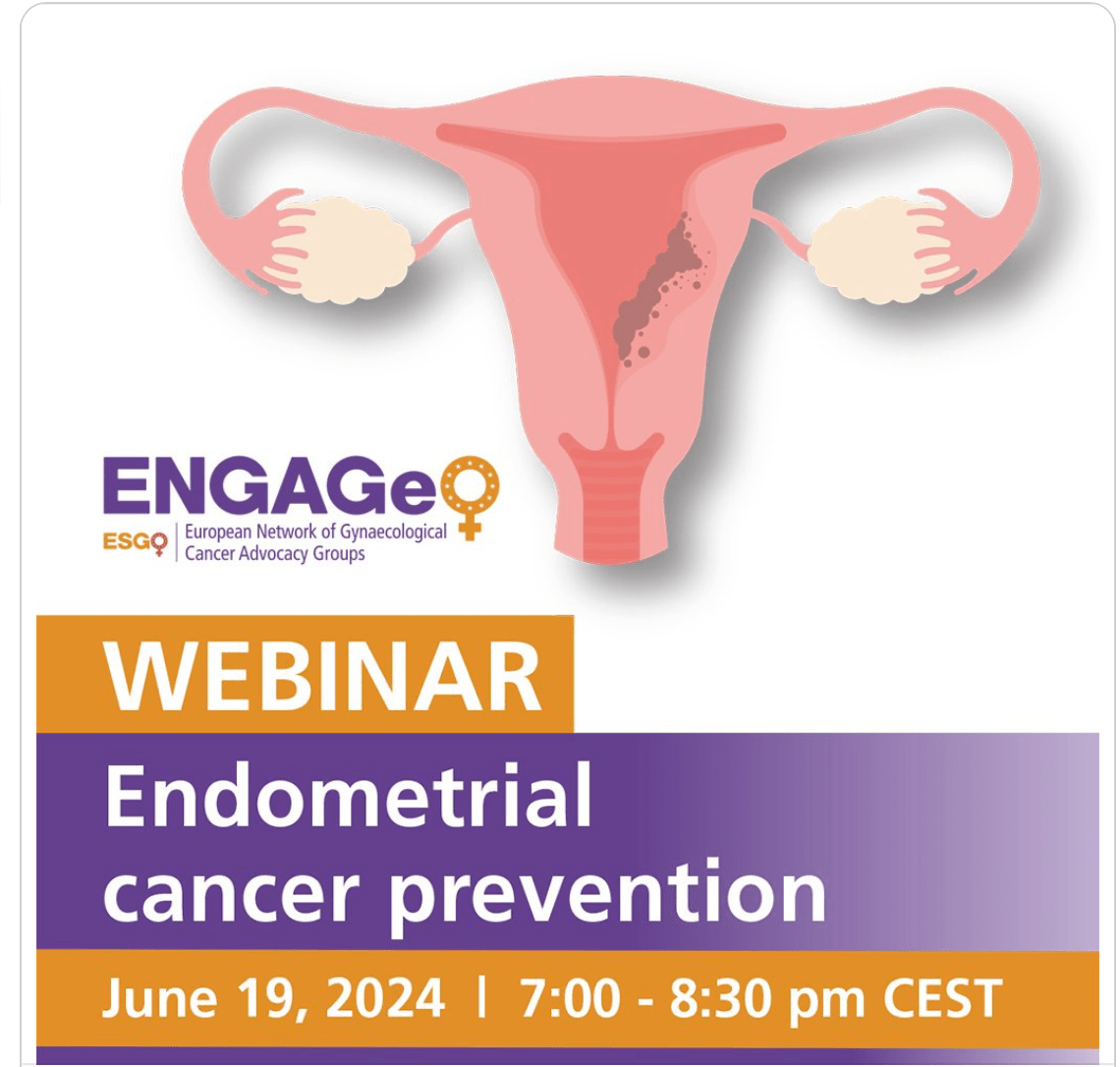
Let’s learn about how to prevent endometrial cancer!

https://engage.esgo.org/…/endometrial-cancer…/

In this webinar aimed at patients and patient advocates, we’ll discuss:

The psychological burden of a diagnosis (M Papageorgiou 🇬🇷)

Medical risk factors (Dr A Stepanyan 🇦🇲)

Genetic risks & prevention (Dr H El Hajj 🇫🇷)

with our co-chairs as moderators: Prof P Morice 🇫🇷 & K Hulscher

Note time is CEST

Discover Available Cancer Support Options in Your Local Community

This directory is designed to help Healthcare Professionals guide cancer patients, their families, and friends to local cancer support services.

It also serves as a valuable resource for individuals living with and beyond a cancer diagnosis, and their loved ones, to discover the available cancer support options.

To access the Directory of Community Cancer Support Centres and Services click https://www.hse.ie/eng/services/list/5/cancer/profinfo/survivorship-programme/nccp-directory-of-community-cancer-support-centres-and-services.pdf