So how would I like to change healthcare? Part 1 of 3

I would like to see a dedicated organisation, with patients involved, looking at excellence in treatment

  • This would not be an ever changing government looking at their own interests or survival.
  • I would like to see centres of excellence, not general hospitals telling you, ‘There is no chance’
  • I would like to see patients as the focus of their treatment, NOT their symptoms!

Guidelines for the management of hereditary colorectal cancer from the British Society of Gastroenterology (BSG)/Association of Coloproctology of Great Britain and Ireland (ACPGBI)/United Kingdom Cancer Genetics Group (UKCGG) -2019

Lynch syndrome (LS)

  • We recommend that for all people when first diagnosed with CRC, testing using immunohistochemistry (IHC) for MMR proteins or microsatellite instability is used to identify tumours with deficient DNA MMR, and to guide further sequential testing for LS. (GRADE of evidence: moderate; Strength of recommendation: strong)
  • We recommend that colonoscopic surveillance should be performed at a 2 yearly interval for all LS patients. (GRADE of evidence: moderate; Strength of recommendation: strong)
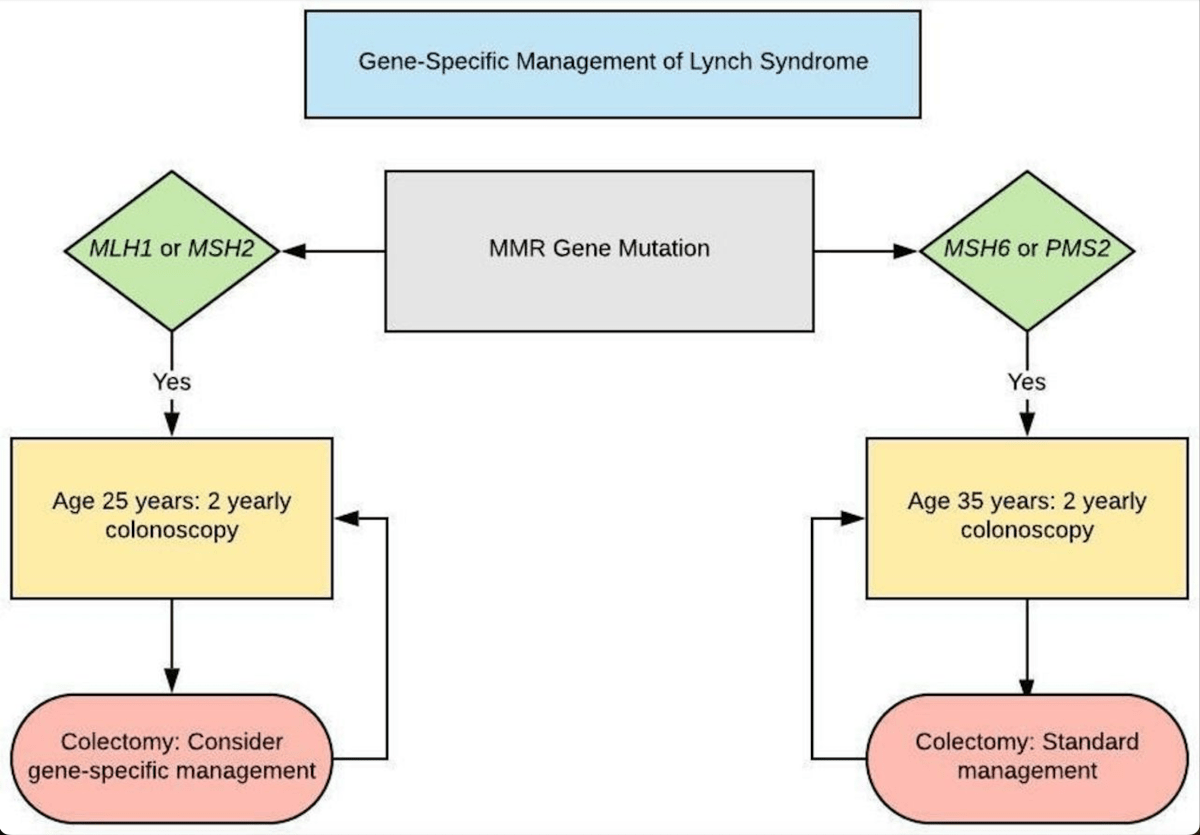
  • We recommend that age of onset of surveillance colonoscopy should be stratified according to the LS-associated gene. We recommend colonoscopy from age 25 years for MLH1 and MSH2 mutation carriers and 35 years for MSH6 and PMS2mutation carriers. There are insufficient data to support stratifying age of onset of surveillance by gender. (GRADE of evidence: moderate; Strength of recommendation: strong)
  • We suggest that for LS patients with MLH1 or MSH2 mutations who develop colon cancer or colonic neoplasia not amenable to endoscopic control, the decision to perform segmental versus total/near total colectomy should balance the risks of metachronous cancer, the functional consequences of surgery, the patient’s age and patient’s wishes. (GRADE of evidence: Moderate; Strength of recommendation: strong)
  • We recommend that for LS patients with MSH6 or PMS2 mutations there is insufficient evidence for oncological benefit of extended colectomy over segmental resection. (GRADE of evidence: low; Strength of recommendation: strong)
  • We suggest that when abdominal-perineal excision can be avoided, a standard low anterior resection is a reasonable option to treat rectal cancers in LS patients, even though the residual colon is at high-risk of metachronous neoplasia. (GRADE of evidence: low; Strength of recommendation: weak)
  • We recommend that gastric, small bowel, or pancreatic surveillance in LS patients is only performed in the context of a clinical trial. (GRADE of evidence: low; Strength of recommendation: strong)
  • We recommend screening for H elicobacter pylori in patients with LS and subsequent eradication therapy if indicated. (GRADE of evidence: low; Strength of recommendation: strong)

https://gut.bmj.com/content/69/3/411

Did Cancer Make You More Grateful?

One of my biggest cancer pet peeves is the one about cancer turning you into a new and improved version of your former self. Somehow cancer makes you a better person.

I don’t agree with that premise and have written about it in more depth here.

SURVIVOR GUILT

Survivor guilt is common in Cancer Land.

Sometimes, you wonder why you’re still here when so many others, often with similar initial diagnoses to yours, are not. Adding guilt into the crapshoot is unhelpful and unnecessary. Nonetheless, add it in we do.

Results of phase I-II bridging study for Nous-209, a neoantigen cancer immunotherapy, in combination with pembrolizumab as first line treatment in patients with advanced dMMR/MSI-h colorectal cancer.

https://ascopubs.org/doi/abs/10.1200/JCO.2023.41.16_suppl.e14665

Conclusions: The combination of Nous-209 and pembrolizumab is safe, well tolerated and shows encouraging clinical efficacy in patients with treatment-naive dMMR/MSI-H mCRC eligible for anti-PD-1 therapy.

The study is ongoing and expanding to Phase II randomisation with a new accelerated Nous-209 vaccination schedule.

Aging After Oophorectomy

“In navigating the effects of accelerated aging post-oophorectomy, HRT can be an essential tool for those who have not achieved menopause. While it can alleviate various symptoms and health risks, it is crucial to discuss its potential benefits and drawbacks with a healthcare provider.”

https://www.curetoday.com/view/aging-after-oophorectomy

Improving Doctor, Patient, and Caregiver Communication

There is a great deal to be gained by improving communication between patients, family caregivers, and healthcare professionals — especially physicians. Better care for patients, less stress for caregivers, more efficient use of doctors’ time, and improved satisfaction for all concerned can be achieved when caregivers and patients communicate effectively with their care team.

Doctors at MSK are learning how to talk to patients, caregivers, and peers through their Communication Skills Research & Training (COMSKIL) program.

In this webchat, MSK experts will discuss how patients and caregivers benefit from this training, as well as how you can use communication techniques, research, and information from the program when talking to your doctors and loved ones.

Exploring Stakeholders’ Perspectives on Implementing Universal Germline Testing for Colorectal Cancer: Findings From a Clinical Practice Survey

CONCLUSION: This study(Eighty CGA-IGC members participated) demonstrates wide support among hereditary GI cancer experts for implementation of UGT for patients with CRC. However, alternative service delivery models using nongenetics providers should be considered to address the logistical barriers to UGT implementation, particularly the growing demand for genetic testing.

In conclusion, there is broad support for UGT for all newly diagnosed patients with CRC among the members of the CGA-IGC.

However, changes to practice, such as alternative service delivery models or standardization of test choice, will likely have to be implemented to meet the increased patient volume.

Additional studies are needed to compare UGT implementation strategies (eg, traditional or alternative service delivery models) to ensure there is equitable access to genetic testing and improved outcomes for patients with CRC.

https://ascopubs.org/doi/full/10.1200/PO.23.00440

The ins and outs and ups and downs of a colonoscopy

So what is a colonoscopy?

A colonoscopy is a test to look at your bowel using a small camera. The test looks for any small growths called polyps, or signs of disease, such as bowel cancer. If polyps are found they are usually removed during the test. This will reduce the risk of cancer developing. If they are not removed they might turn into cancer. If bowel cancer is found early, it’s easier to treat and there’s a better chance of recovery.

https://bit.ly/3lWzc80