Gene-Specific Detection Rate of Adenomas and Advanced Adenomas in Lynch Syndrome

Colonoscopy is expected to reduce colorectal cancer (CRC) incidence in Lynch syndrome (LS) by detecting and removing adenomas. The existence of gene-specific differences in adenoma detection has been proposed yet remains insufficiently explored.

Conclusions

Carriers of MLH1/MSH2 pathogenic variants are at a higher risk of developing AAs compared with those with MSH6/PMS2 mutations, with MSH6 carriers exhibiting an intermediate risk profile. Advanced adenomas(AA) are an independent risk factor for post-colonoscopy CRC . LS patients with AAs should be identified as high risk and undergo enhanced colonoscopy surveillance.

https://www.sciencedirect.com/science/article/abs/pii/S001650852500650X?dgcid=author

Diagnosed with Colon Cancer: 10 Tips on How to Get The Most From Your Doctor

Be Your Own Advocate

Build your colorectal cancer treatment team: -You, of course, are the starring player.

Make sure you have an overall care coordinator.

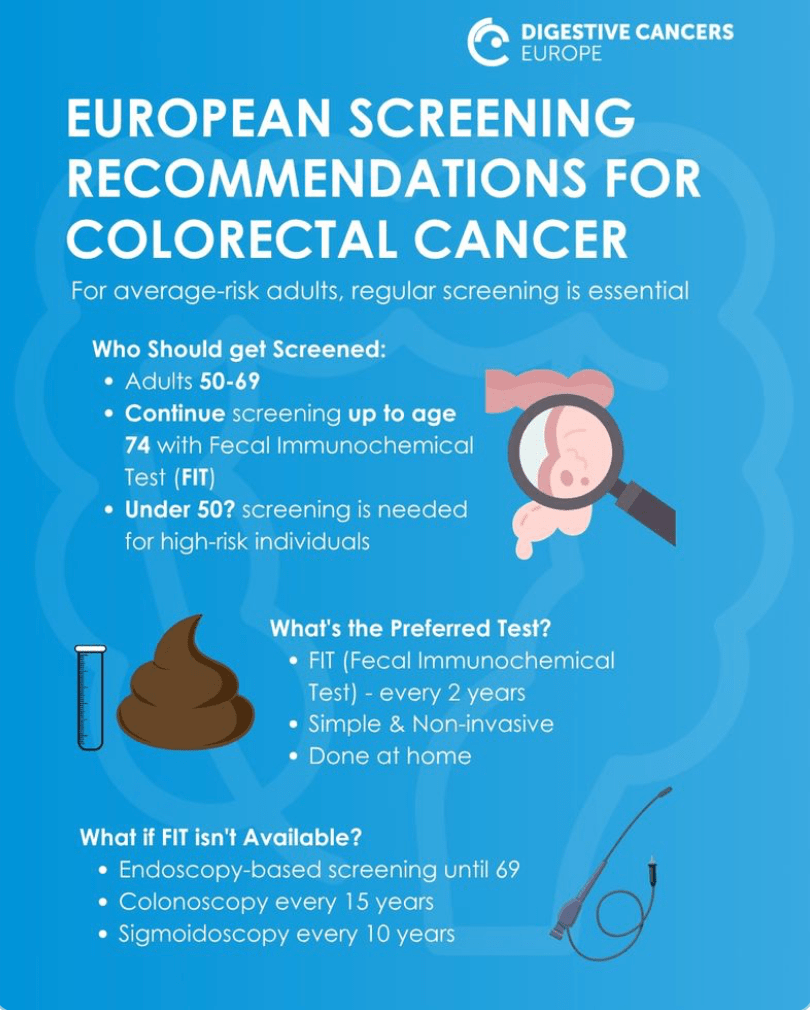
Screening for Colorectal Cancer

The European Commission’s Joint Research Centre (JRC) has just published updated recommendations on colorectal cancer screening tests and strategies for getting people to participate in screening.

Study: Two immunotherapy drugs are better than one for some metastatic colorectal cancers

Combining two immunotherapy drugs is a more effective treatment for certain metastatic colorectal cancers than using either treatment drug alone.

CheckMate 8HW trial used together, Opdivo (nivolumab) plus Yervoy (ipilimumab) slowed cancer growth in MSI-High metastatic colorectal cancers, a type of colorectal cancer often found in Lynch syndrome.

The FDA approved this combined treatment for MSI-High metastatic colorectal cancer after progression with chemotherapy.

Note: People with Lynch syndrome who have colorectal cancer commonly have MSI-H or dMMR cancers.

https://www.thelancet.com/journals/lancet/article/PIIS0140-6736(24)02848-4/abstract

We need you…

Please consider joining our closed group if you have inherited the Lynch syndrome predisposition to cancer or are part of a family that has this mutation. We would love to welcome you.

Simple process…just select the “Sign Up” button on our open Facebook page.

https://www.facebook.com/lynchsyndromeirl/

IV Complications and the Challenge of Being Heard

Key Takeaways
  • Self-advocacy is crucial in healthcare, especially for patients with chronic conditions like cancer, to ensure proper care and treatment.
  • Recognizing signs of IV infiltration and extravasation is vital for patients receiving intravenous treatments to prevent potential tissue damage.
  • Effective communication and assertiveness are essential when voicing concerns to healthcare providers to avoid dismissive responses and ensure patient safety.
  • Trusting one’s instincts and understanding one’s body can significantly impact the quality of care received in medical settings.

https://www.curetoday.com/view/iv-complications-and-the-challenge-of-being-heard

Preventing Ovarian Cancer: Living With Consequences

Key Takeaways:
  • Lynch syndrome can necessitate early oophorectomy, leading to abrupt surgical menopause and significant health impacts due to sudden estrogen loss.
  • Estrogen plays a crucial role in protecting bones, joints, brain, heart, and emotional well-being, with its absence exacerbating conditions like osteoarthritis and cardiovascular disease.
  • The narrative calls for broader menopause discussions, including the experiences of women undergoing early surgical menopause, and emphasizes the need for more research and nuanced care.
  • The author stresses the importance of managing chronic conditions and mental health post-surgery, advocating for better support and understanding for women facing similar challenges.

https://www.curetoday.com/view/preventing-ovarian-cancer-living-with-consequences?fbclid=IwY2xjawLxciJleHRuA2FlbQIxMABicmlkETB6S0xyT01CVGNNS3pubzNoAR55anv9w480ijD0-9z9uyhoKUcimZWF2FOXBw3KaopIo4QZXQ7C83om8K4goQ_aem_ApoJirQV0HbAzrqG8nUxYA

Cancer Revolution: Science, Innovation and Hope – Aug 15th to Sept 5th (Free Event)

Through seldom and never-before seen objects and stories, cutting edge treatment and research, reflection, film, photography, interactive exhibits and a breadth of personal stories – this exhibition presents the stories of people affected by cancer, together with those who study and treat it. Revealing how researchers, clinicians, policy makers and patients are fuelling progress in a powerful expression of shared hope.

Shaped through collaboration with people living with and impacted by cancer, the exhibition will take visitors on a journey of discovery with scientists, clinicians and people who have been affected by cancer in their own words. Explore everything known so far about what cancer is and what causes it, why scientists are focusing their research on understanding how and why cancer evolves, and what the future of cancer care looks like.

The exhibition reveals how cancer has been treated over the centuries, from high-risk surgeries to the discovery of the first chemotherapy drugs, and the important challenges that remain to be solved.

 National Electronic Health Record (EHR)

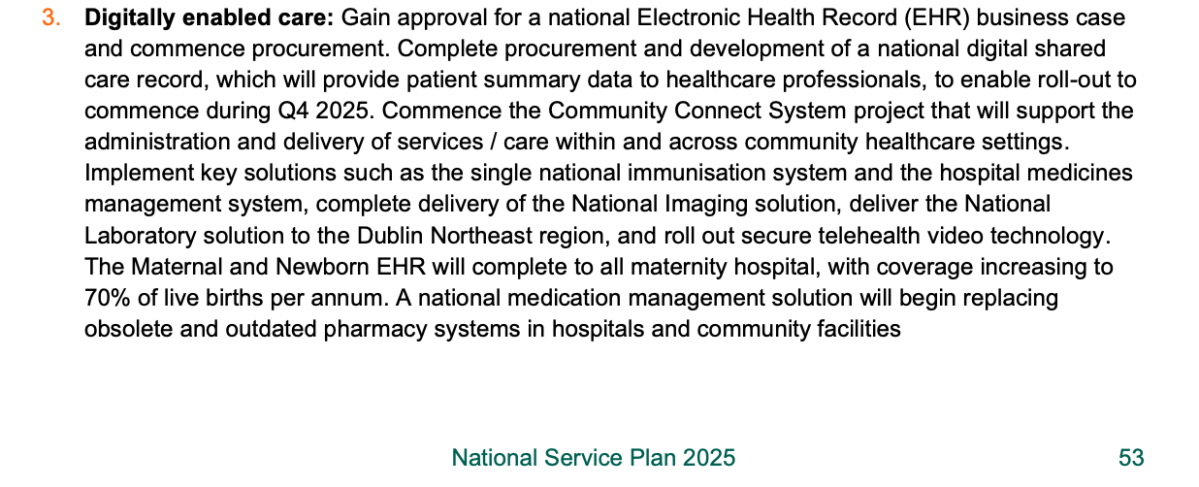
EHR will be a digital system that holds a person’s full health and social care information in one place. It will replace paper files and local IT systems by allowing staff to record, update and access all health information in one place.

Access to digital health records has been a long-sought objective in Irish healthcare for many years.

To date(March 25), the Health Service has rolled out a number of electronic health record (EHR) systems in different sites in recent years. These include the National Rehabilitation Hospital, the National Forensic Mental Health Service, St. James Hospital, Mater Misericordiae University Hospital, roll-out across the bigger Maternity Hospitals extending EHR coverage to 70% of births nationally by the end of 2025. The National Children’s Hospital EHR deployment will be the most comprehensive EHR deployment in the state when the hospital is commissioned.

Ireland needs one digital health record for every citizen that can be access by health professionals across the service.

To achieve this, the HSE are following a three-step approach: delivering the HSE Health App, developing a National Shared Care Record (NSCR), and regional deployments of enterprise level Electronic Health Record systems that span acute and community healthcare.

HSE has completed the procurement for the National Shared Care Record (NSCR) programme and has now been mobilised, with the contract for building the NSCR technology platform awarded to EY, Better and Kainos.

The NSCR brings together healthcare information from various sources such as hospitals, GP practices, and Community care into a single place, making them available at the point of care and self-care in read only format. By having access to key healthcare information in one place means healthcare professionals will be able to make more informed, safer decisions and to focus more time on direct patient care while patients will be better informed and empowered to manage their own healthcare. 

A phased roll-out of the national shared care record is due to commence in Q4 2025 in the South-East region with University Hospital Waterford. The system will then extend to other regions from 2026 with additional information being added over time.

https://www.oireachtas.ie/en/debates/question/2025-03-04/696/

How Cancer Spreads: Four Emerging Insights About Metastasis

“Metastasis used to be an automatic death sentence, but that is no longer the case,” he says. “In some cases, it is now curable with immunotherapy, and for many cancers it is becoming more controllable. We are probably never going to eliminate it — but we are moving closer and closer to being able to prevent it in some cases, and to manage it the same way we manage other chronic diseases.