Diagnosis and management of Lynch syndrome

Recently, an appreciation of the mechanism of carcinogenesis in LS-associated cancers has contributed to the development of novel therapeutic and diagnostic approaches, with a gene-specific approach to disease management, with potential cancer-preventing vaccines in development. An adaptive approach to surgical or oncological management of LS-related cancers may be considered, including an important role for novel checkpoint inhibitor immunotherapy in locally advanced or metastatic disease. Therefore, a personalised approach to lifelong gene-specific management for people with LS provides many opportunities for cancer prevention and treatment which we outline in this review.

https://fg.bmj.com/content/early/2022/06/01/flgastro-2022-102123

Is colon cancer hereditary?

All cancers are genetic because changes in genes cause cells to grow out of control, leading to the disease. However, genetic does not mean hereditary

Hereditary cancers are cancers that pass from generation to generation via genes. These cancers comprise only a small portion of colon cancers.

Lynch syndrome causes about 5% of all colorectal cancers.

thisisgo.ie Cancer Genetics Section

Women’s health resources has just gotten a whole lot better! With the launch of http://thisisgo.ie cancer genetics today.

“We see women and their families impacted by gynaecological cancer as partners in their care” 

Two Fellows Use Online Resources to Boost Genetic Testing

The most commonly cited barriers to testing are lack of awareness, difficulty of access, and cost(USA)….despite known benefits, uptake for genetic testing has been slow: only 1 in 5 individuals use recommended genetic services even when there is a significant family history of colorectal, breast, or ovarian cancer.

Early detection of hereditary cancers and subsequent medical or surgical intervention decreases mortality, therefore this missed opportunity means an immense loss of lives.

https://www.onclive.com/view/two-fellows-use-online-resources-to-boost-genetic-testing

The National(UK) Lynch Programme supported by 40tude

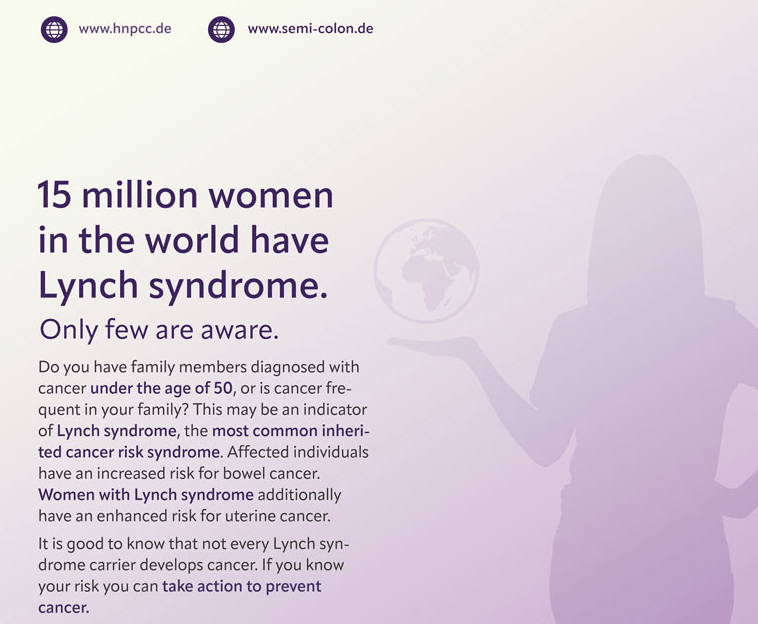
Most people with Lynch syndrome are well, but someone with LS has a 40-70% chance of developing colon cancer, and women also have a similar risk of cancer of the womb.  All those with LS have an increased risk of many other types of cancer.   The genetic mutations which cause Lynch Syndrome can be passed on from one generation to the next, with a 50% risk of a child inheriting this condition.

The programme has four main aims:

1) Effective diagnosis and identification of people with LS in the UK

2) Improve understanding of the biological mechanism of cancer development of people with LS

3) Develop additional tests which facilitate the prevention and early diagnosis of cancer in people with LS

4) Reduction in the variation of – and improvement in access to – care for people with LS in the UK

Lynch Syndrome: everything you need to know(Ovarian Cancer Action UK)

A genetic mutation like Lynch syndrome is not a guarantee that you will develop cancer, but it gives you an increased risk that you will be diagnosed with certain cancers in your lifetime. 

https://ovarian.org.uk/ovarian-cancer/lynch-syndrome/

Experiencing ovarian cancer symptoms? How to talk to your GP about your concerns

GPs play a crucial role in the diagnosis of ovarian cancer. There are several reasons why ovarian cancer might not be on a GP’s radar if a patient presents with its main symptoms, particularly as ovarian cancer symptoms are vague and may be caused by more common conditions. We know, however, that sometimes women feel like their symptoms are not being taken seriously or have been misdiagnosed.

We always advise anyone to go to a doctor if they feel something isn’t right, but how do you make yourself heard?

Symptoms Diary:

thisisGO.ie is an online personalised resource for you and yours who have been impacted by a gynaecological cancer.

This programme is part of the Irish Cancer Society’s Women’s Health Initiative (WHI), the aim of which is to improve health and wellbeing for women impacted by cancer who are dealing with the side effects and consequences of treatment.

Phases of thisisGO

Phase 1 was launched on September 20th 2021.  It is a personalised
online resource for women impacted by cervical cancer. If you have a partner in
your life, this platform can also support them. If you are a health care
provider working in the area this can also support you and your
practice. 

If you are newly diagnosed, receiving treatment, in surveillance
or living well with and beyond cancer thisisGO.ie has information that is
tailored to meet your needs.

Phase 2 covered ovarian cancer and was launched on the 4th of
February 2022

Next Phase due shortly will cover Genetic Cancers including BRCA and Lynch Syndrome

It is hoped that the remaining three gynaecological cancer and
GO cancer genetics will be complete before the end of 2022.

Each gynaecological cancer has different symptoms.

If you are experiencing any of the symptoms in the chart below for more than two weeks, please make an appointment to see your doctor to discuss further.

You may feel embarrassed discussing some of these symptoms, this is normal, your doctor is here to help, and it may save your life.

(www.thisisgo.ie)