The European Tumour Group Podcast

Delving into the world of hereditary cancer conditions, featuring conversations with opinion leaders, experts, cutting-edge researchers, and patients. Episodes explore key issues, groundbreaking research, and personal stories that shape the understanding, prevention, and treatment of hereditary cancer syndromes. Stay informed and inspired with every episode!

Who better to start it with than our very own @CaPP3 Sir John Burn

https://rss.com/podcasts/the-european-tumour-group-podcast/

What is an orphan drug?

The so-called ‘orphan drugs’ are intended to treat diseases so rare that sponsors are reluctant to develop them under usual marketing conditions.

Efforts have been jointly made at national and European levels by industry and health authorities (EMEA – European Medicines Evaluation Agency), in order to offer the incentives required to stimulate the development of orphan drugs. The goal was to rapidly make available, for rare diseases, drugs with a level of quality equivalent to that required for any other drug.

https://www.orpha.net/en/other-information/about-orphan-drugs?stapage=europe

A patient-led survey on information and communication needs of patients with metastatic breast cancer in Ireland and Northern Ireland

Women with advanced breast cancer are living longer thanks to better treatment but they are “invisible” in services which could support their changed lives, a patient and scientist has warned.

This could easily apply to other cancers as well. “The experiences of patients with different cancers is more alike than different”

https://doi.org/10.1016/j.breast.2024.103837

Prostate Cancer Survey

The PRO-ACT Survey is live! Developed with input from patients, partners, & healthcare professionals, this study explores the impact of prostate cancer treatment on sexual well-being and mental health.

The hope is that the insights gathered will improve care and support for patients in the future.

https://bit.ly/4gbjMTG

The findings will identify gaps in current services and communication, helping to develop resources that provide more holistic and effective support.

Survey links:

Patient Survey: https://www.surveymonkey.com/r/YGNKN5T

Partner Survey: https://www.surveymonkey.com/r/2WC2J38

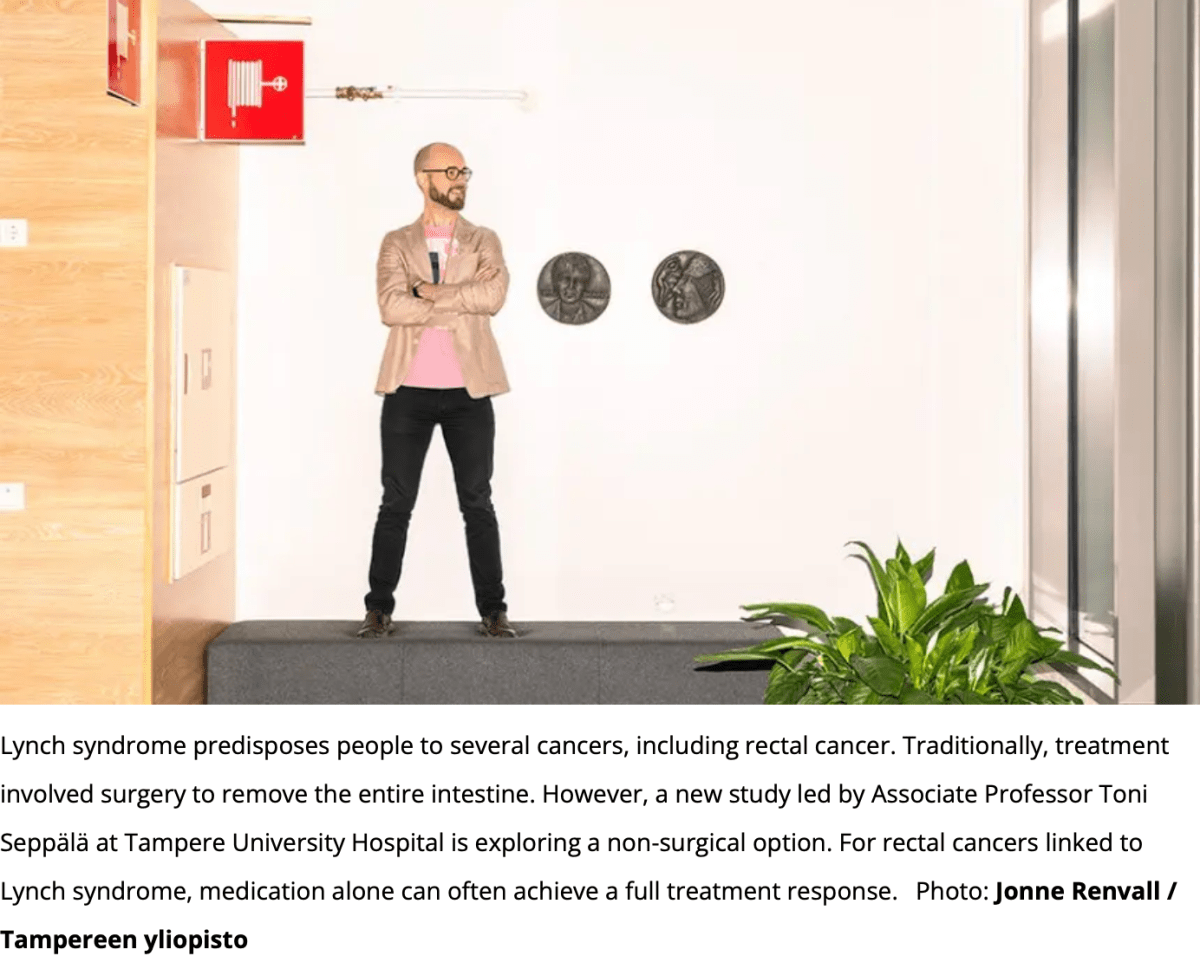
A genetic mutation can save lives – Lynch syndrome paves the way for cancer vaccines and personalised treatments

While Lynch syndrome increases the risk of cancer for its carriers, it also provides a unique opportunity to understand disease mechanisms. It is likely that the first preventive cancer vaccine will be specifically developed against cancers caused by Lynch syndrome.

From the individual’s perspective, Lynch syndrome and its prevalence in the population is not a positive thing, but from the research standpoint it is, meaning that the disease can also benefit patients.

“Currently, there is intense development work on cancer-preventive vaccines, which will soon be tested in large patient groups. The most progress has been made with cancers linked to Lynch syndrome. It will be a major breakthrough when we can prevent cancers that we know are likely to develop,” Seppälä says.

In Lynch syndrome, identifying carriers of the genetic mutation is vital because healthcare interventions can greatly benefit these patients. Generally, there needs to be greater awareness in society about the importance of molecular profiling. 

https://www.tuni.fi/en/news/genetic-mutation-can-save-lives-lynch-syndrome-paves-way-cancer-vaccines-and-personalised

Mainstreaming cancer genetics: feasibility of an advanced nurse practitioner-led service diagnosing Lynch syndrome from colorectal cancer in Ireland

https://link.springer.com/epdf/10.1007/s10689-024-00427-7?sharing_token=vcZ4EunQc5ITtewhq4GRV_e4RwlQNchNByi7wbcMAY5LEtPAgAgZTSbin5mUumNCFiB1qx9wTaz4jrQEKpjM0RmHU8LXULyUeLp18KKlkM4J6QaWK0NN9Y0ti8jkfM8NanE_4j6sCuve_66FVrquRuZADCeNjpz0Dj6PlMYN0dE%3D

Conclusion: Access to and timely delivery of specialist cancer genetics services represents a substantial unmet need in Ireland, the requirement for which is projected to increase significantly over the coming years. Our institutional experience confirms the feasibility, efficiency and efficacy of an ANP-led mainstreamed model of care for hereditary colorectal cancer. The development of this service aligns with national healthcare priorities to deliver timely and appropriate cancer genetics services in a coordinated way integrated with the patient’s cancer care pathway. Development and expansion of similar services would facilitate enhanced delivery of cancer genetics services into routine clinical practice, ensuring uniformity, safety, high quality, and cost-effective care. However, this will necessarily require appropriate resourcing and investment.

Uptake of Aspirin Chemoprevention in Patients With Lynch Syndrome

Two hundred and ninety-six participants completed the survey.

Uptake of regular ASA or NSAIDs was modest at 34.8% and was even lower (25.7%) when focusing on individuals taking ASA or NSAIDs solely for chemoprevention of LS. More than half (55%) were taking <100 mg ASA daily.

Conclusion: Patient perceptions of the pros and cons of ASA, more so than demographic and disease-related factors, were associated with chemoprevention uptake.

https://ascopubs.org/doi/10.1200/PO-24-00562

In an Ideal World: We would have….

  • A central point to support people who are affected by Lynch Syndrome or other Genetic Cancer defects.
  • An integrated Cancer Genetics service.
  • An increased Genetics workforce.
  • A Genetics Testing center in Ireland.
  • A comprehensive IT system to Manage/Track and generally improve the collection/storage of relevant information.
  • Improved awareness by Public and Medics of Genetics.
  • A dedicated Pathway for people with a genetic cancer issue.
  • Improved support available to help in relaying a diagnosis to the wider family.
  • A national BioBank to improve/help research in this area.

Molecular Tumour Board

Molecular Tumour Boards (MTBs) are a specific type of multi-disciplinary tumour board meeting in which anonymized patient cases are discussed based on the patient’s clinical information and genetic sequencing reports. 

Their vision is to change the way cancer patients in Ireland are treated building on a Molecular Tumour Board.

By fostering collaboration on cancer treatment decisions among Irish clinicians with support of national and international experts from the medical and scientific community, the MTB is driving the transition towards precision oncology and personalised healthcare.