Meet Emilia, endometrial cancer patient support!

Throughout June, Emilia will share her whole story, from the first warning signs, diagnosis, through treatment, recovery, and life after cancer.Emilia will shine light on the patient pathway of endometrial cancer!

Emilia noticed she had some strange symptoms that wouldn’t go away.
It was scary, but she went to her doctor and explained her fear…..

Precision Medicine

For decades, genetic testing was rationed, reserved only for patients who fit narrow, outdated clinical guidelines. But what happens when those guidelines leave countless people at risk?

In this episode, clinical geneticist and medical innovator Dr. Ed Esplin of LabCorp Genetics reveals how his team’s groundbreaking research exposed the flaws in restrictive testing policies. Through rigorous studies in breast cancer, colorectal cancer, and beyond, they proved that universal germline genetic testing identifies far more at-risk patients than guidelines ever predicted and fundamentally changes how we treat and prevent disease.

The data has forced a reckoning: when up to “50% of high-risk patients were being missed”, “standard of care” was anything but standard care.

From community oncology clinics to rare disease diagnostics, he makes the case that access to genetic insights should be driven by evidence, not just eligibility criteria.

Cancer: A word to dread, to not fear and NEVER to celebrate

Those of us going through or have gone through cancer can’t escape the utter dread you feel when that medical person tells you to your face you have cancer. Regardless of the type or severity of cancer, you hear that word in your ears, you feel that word enter your body, mind and psyche, your world stops. Your mind goes blank.

My progress and response to my ongoing treatment for inoperable prostate cancer has been extremely encouraging. I hope to be given great news around the second anniversary of my diagnosis next October. It’s by no means a given. I must stay focussed and positive. And I will. I am grateful for all I have despite that life-changing day nineteen months ago.

Cancer is a fucking curse. Cancer is a wrecking ball, physically and mentally. Be grateful if it never comes to your door. Be better in life. We’re not perfect, we all do and say stupid things, so we can all be better. But be better.

https://irelandfaneuro2012.wordpress.com

Getting the CMMRD Facts Straight After Family Loses 3 Children in 6 Years to Hereditary Cancer Syndrome

Originally published February 29, 2016

Lynch syndrome is an autosomal dominant condition. This means that a person who carries one copy of a mutation in any of the genes known to cause Lynch syndrome is at increased risk to develop multiple adult-onset cancers, especially those of the colon, uterus, and ovaries.

A person who carries two mutations in the same gene in any of the genes associated with Lynch syndrome (MLH1MSH2MSH6PMS2) has a completely different syndrome called Constitutional Mismatch Repair Deficiency (CMMRD). This usually occurs when a person inherits one mutation from their father and the other from their mother. This rare condition is associated with a high risk of early-onset cancers, including childhood onset cancers of the brain and blood. Café au lait spots, flat light-brown birthmarks on the skin, are also common.

https://www.mygenecounsel.com/getting-the-cmmrd-facts-straight/

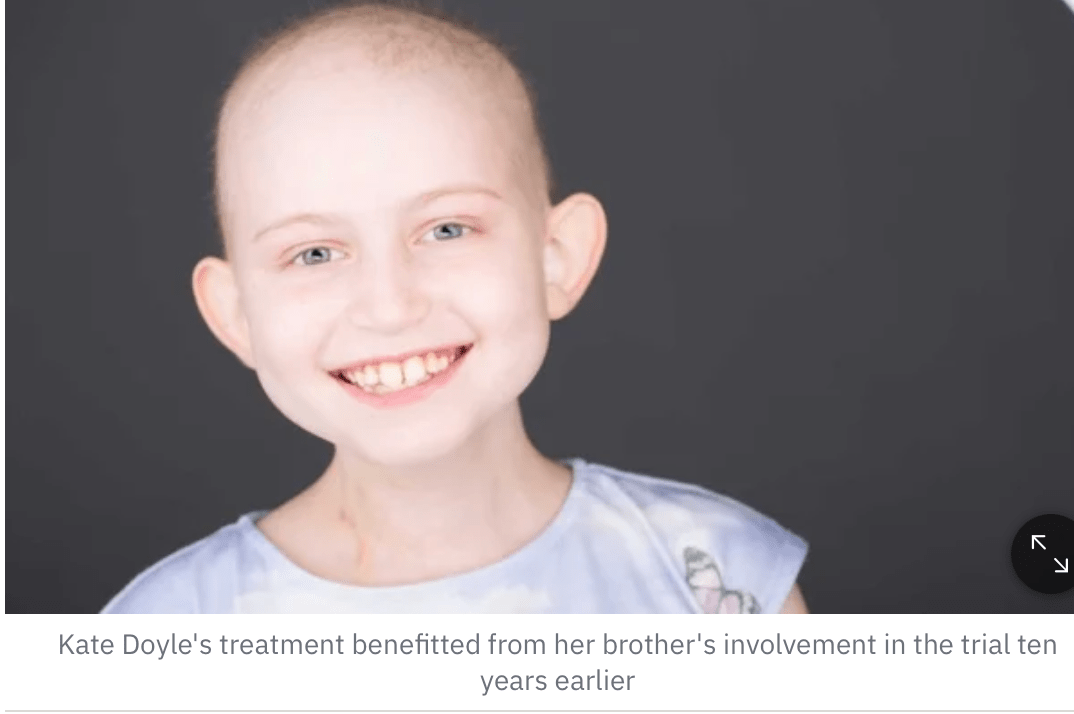
‘Phenomenal’ – study hailed a significant milestone in child cancer care

Professor Owen Smith, Consultant Paediatric Haematologist at Children’s Health Ireland (CHI), has launched Ireland’s first clinical study of genomics approaches in cancer care.

Genomic sequencing allows medical teams to better identify cancerous cells and target them specifically.

“We need to stop carpet bombing cancers and go for a more sniper fire or precision way of killing the cancer and reducing the side effects to the patient,” Prof Smith said.

“Genomic sequencing of the cancer and the patient will allow us to define the patients where chemotherapy can be safely reduced,”

The primary objective of MAGIC-I is to evaluate the clinical and health economic impact of implementing genomic diagnostics in paediatric cancer care in Ireland.

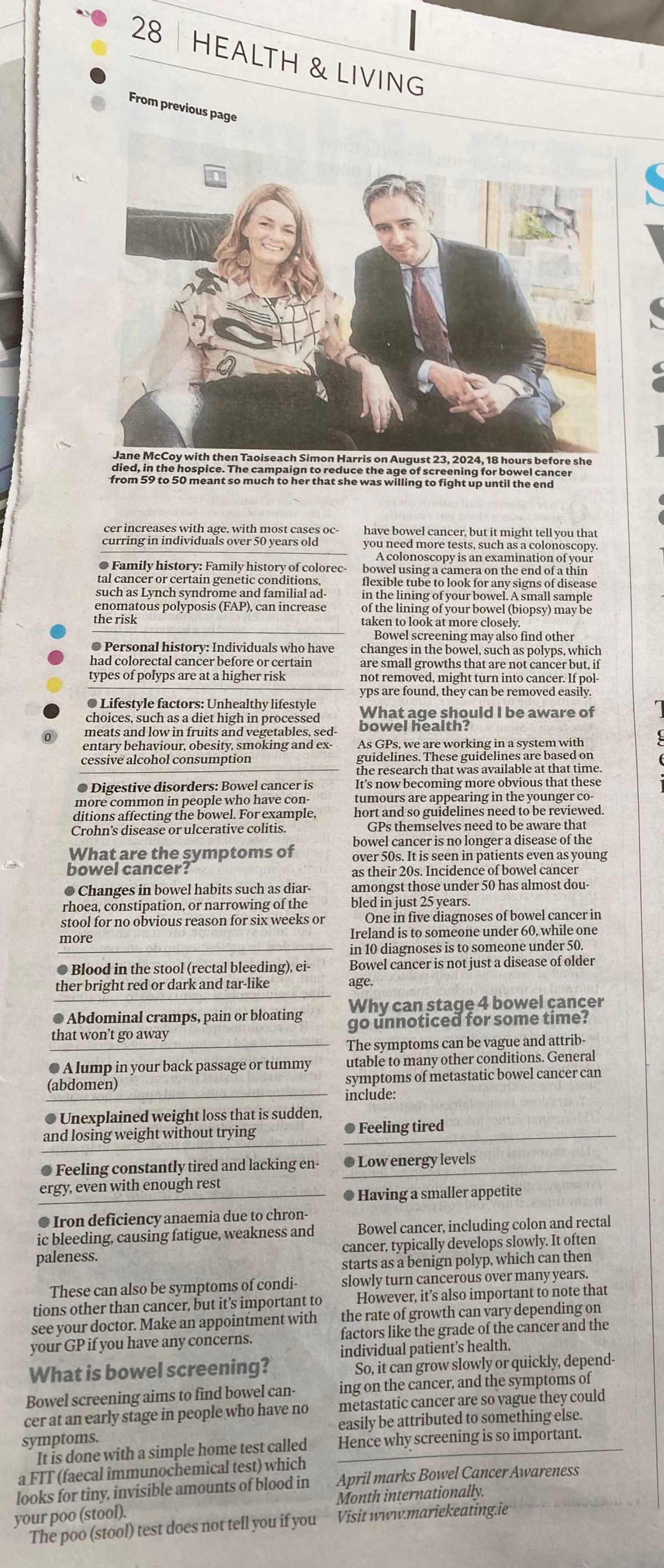
Bowel Cancer: the facts

Dr Fiona Macken: Irish Independent – Health & Living

Are there particular risk factors for Bowel Cancer?

Lynch syndrome- Georgia

Fighting against misinformation and watching science be dismissed is draining.

Social media, once a tool for connection, has become a battleground—especially platforms like Twitter (now X) and Facebook, where conspiracy theories and political toxicity overshadow genuine efforts to help.

Late side effects of chemotherapy

Most chemotherapy side effects are temporary. They get better once your treatment is over. For some people chemotherapy can cause long term changes in the body months or years after treatment.

https://www.cancerresearchuk.org/about-cancer/treatment/chemotherapy/side-effects/late-effects

 “On days like this I wonder why there is so little help available for those, like me, who suffer from them.”

Colonoscopies – Why bother?

It just might save your life.

During my third colonoscopy colon cancer was discovered and it had advanced to my Lymph Nodes. I had no symptoms.

Why was I having colonoscopies? I had a family history of colon cancer and my sibling had tested positive for Lynch syndrome (an inherited predisposition to certain types of cancers including colon and endometrial.

I can understand why many people are nervous about getting colonoscopies. Some wonder how long a colonoscopy will take, how best to prepare for the procedure, how much time you’ll need to take off from work and how embarrassing or disruptive this important cancer screening procedure will be.

Why should people get colon cancer screenings?

The answer is simple: colon cancer screenings can detect colorectal cancer early and prevent unnecessary deaths. Colorectal cancers also are highly preventable and treatable if detected early. In fact, if doctors detect pre-cancerous polyps during a colonoscopy, they can remove the polyps during the procedure.

Prior to Colonoscopy:

Some may think…it’s not pleasant(although having had more than 15 to date I can say I do not find it so, but including the preparation, in most cases you’re spending less than 24 hours to help prevent cancer

Typically, people prepare for a colonoscopy in their homes the day or the night before along with amending their diet for a few days prior to the procedure. The Bowel preparation prescribed — which involves drinking a lot of water along with prep – can take a number of hours . That’s because you’ll be peeing and pooping out all the waste from your body, so you’ll have a clean, empty colon.

Colonoscopy Procedure:

The actual procedure is quick – usually less than 30 minutes. The doctor inserts a scope into your rectum. You are fully sedated prior to the start of the procedure and you wake up after it is over and you usually don’t remember any of the procedure. For nearly everyone, the actual colonoscopy is painless and relatively quick. You wake up, and you’re done. Aside from not being able to drive themselves home from the procedure, most people feel well and are able to eat and drink normally after a colonoscopy.

What are polyps and how common are they?

Polyps are like skin tags that form on the lining of the colon. Some of them are pre-cancerous, which means that over a period of time, they could become cancerous. So, when polyps are found during a colonoscopy, they can easily remove the vast majority of them. That’s how colon cancer is prevented through colonoscopy.”

https://www2.hse.ie/conditions/bowel-screening/colonoscopy-after-bowel-screening/