Does cancer run in my family?

Cancer in your family may be caused by an inherited genetic change if:

  • You have a close (‘first degree’) relative, such as a parent, brother, sister or child, who has been diagnosed with 2 separate cancers. For example, bowel cancer and endometrial (womb) cancer
  • 2 or more close relatives on the same side of your family have had the same cancer
  • You or one of your relatives have a cancer most commonly seen in the opposite sex (for example, male breast cancer)
  • You have Ashkenazi Jewish ancestry
  • You have had cancer at a younger age than commonly seen (for example, bowel cancer under the age of 50)

This list is a guide only. If any of the above points apply to you, it is possible, but not certain, that you have an inherited genetic cause for cancer in your family.

https://www.cancer.ie/cancer-information/about-cancer/cancer-and-genes

https://www2.hse.ie/conditions/lynch-syndrome/

Lynch Syndrome UK – New Website

Check out their newly launched version….lots of information that you might find useful.

https://www.lynch-syndrome-uk.org

The diagnostic accuracy of the faecal immunochemical test(FIT) for the detection of early-onset colorectal cancer: an age-stratified analysis in South West England

The faecal immunochemical test (FIT) is a diagnostic triage tool for patients presenting with clinical features of CRC in primary care, though its performance in individuals under 50 years is not well established.

Conclusions: FIT performs excellently for patients aged 40-49; however, it may not be used optimally in patients <40 years. A more targeted strategy is needed to guide investigation in younger patients.

https://pubmed.ncbi.nlm.nih.gov/40847011/

Universal Healthcare Insurance model

Sláintecare is Ireland’s reform plan to create a universal, single-tier health and social care system based on patient need, not ability to pay, moving away from its current two-tier system

Sláintecare 2025+ aims to forge the way towards accessible, affordable, high-quality, healthcare for the people of Ireland when they need it, where they need it. 

michaeltmccarthy @mccarthymt7


Prospective Lynch syndrome database

A prospective Lynch syndrome database is important because it allows researchers, clinicians, and policymakers to collect and analyse long-term, standardised data on people with Lynch syndrome (LS).

(Using Chat GPT)

📌 In short: A prospective Lynch syndrome database is essential because it produces high-quality, unbiased evidence on cancer risks, surveillance effectiveness, and preventive strategies, directly improving patient care and shaping clinical guidelines.

Here are the key reasons why it matters, based only on reliable clinical and research perspectives:

  1. Natural history understanding
    • Prospective data (collected forward in time) helps clarify the true risks of different cancers (colorectal, endometrial, ovarian, gastric, etc.) in Lynch syndrome carriers.
    • It reduces biases compared to retrospective reports, which often overestimate risks due to selective reporting of severe cases.
  2. Better risk stratification
    • Different mismatch repair (MMR) gene variants (MLH1, MSH2, MSH6, PMS2, EPCAM) carry different cancer risks.
    • A prospective database helps define more precise, gene-specific and even sex-specific risk estimates, which guide personalized surveillance.
  3. Evaluation of surveillance effectiveness
    • Prospective registries allow direct measurement of how colonoscopy intervals (e.g., every 1–2 years) affect cancer incidence, stage at diagnosis, and mortality.
    • They can test whether surveillance reduces advanced cancers, enabling evidence-based guideline updates.
  4. Assessment of preventive strategies
    • Allows evaluation of risk-reducing interventions such as aspirin (e.g., CAPP2/CAPP3 trials), prophylactic surgeries, or lifestyle modifications.
    • Can help identify who benefits most from preventive measures.
  5. Improved clinical counseling
    • Physicians and genetic counselors can give patients more reliable, individualized risk information, reducing uncertainty and supporting informed decisions.
  6. Data for health policy
    • National or international databases provide evidence for cost-effectiveness of surveillance and preventive programs.
    • This supports resource allocation and insurance coverage for Lynch syndrome management.
  7. Research opportunities
    • Creates a resource for studying modifiers of cancer risk (genetic, environmental, lifestyle).
    • Enables collaboration across centers and countries for rare cancers within LS populations.

https://plsd.eu

BETWEEN HOPE AND HYPE: WHAT CANCER BLOOD TESTS REALLY MEAN FOR PATIENTS

For us as advocates, the message is clear: celebrate the progress, but guard against the hype. Stories of individual breakthroughs are moving — but without long-term, carefully designed trials that measure not just detection but survival, we risk creating false reassurance or unnecessary harm.

The real “holy grail” is not simply detecting cancer earlier. It is learning to distinguish between cancers that demand urgent treatment and those that do not; between signals of danger and signals of noise. Only then will early detection truly translate into lives saved.

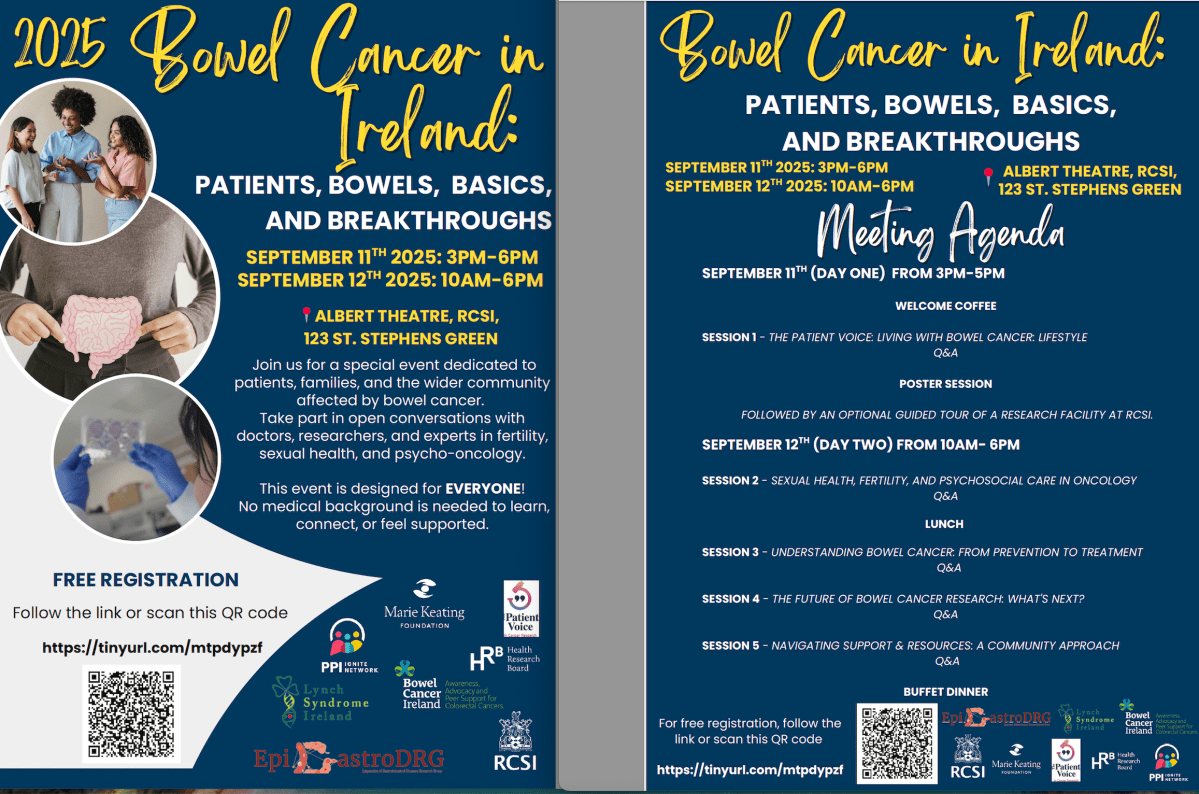
Bowel Cancer in Ireland: 

Patients, Bowels, Basics, and Breakthroughs
On 11th & 12th September, RSCI is holding a bowel cancer event dedicated to patients, families, and the wider community affected by this cancer. 

PVCR Chair Prof Amanda McCann is leading a session on Friday 12th September at 1:30pm on “The Importance of PPI in Research” with PhD students from ColoMARK and patient advocates from Bowel Cancer Ireland.

There will also be open conversations with doctors, researchers, and experts in fertility, sexual health, and psycho-oncology across the two days. 

You can click here or scan the QR code below to register. Any questions or concerns can be directed to EpiGastroDRG@outlook.com

You can also check out their free bowel cancer informational booklet here or through the QR code below to the right.

Patients, Bowels, Basics and Breakthroughs

Very excited to share that @rcsi_irl ‘Patients, Bowels, Basics and Breakthroughs’ is back!!!

This two day event is aimed at bringing together the patient & professional community to explore the landscape of bowel cancer, with focus on the unique challenges of early-onset disease like fertility, sexual health and much more!

Learn about the latest research directly from those carrying out the work! It will feature fantastic speakers from across Ireland, the UK and Europe and powerful patient voices sharing their lived experiences.

There’ll be exciting panel discussions, a poster session and even a lab tour! 

What makes this event even more special is the people behind it. The fabulous (and I mean fabulous!) RCSI Epigastro Disease Research Group who have opened their doors to ourselves at @lynchsyndromeireland & @BowelCancerIreland and welcomed us as valued team members to co-organise these important events. This is more than patient involvement this is true PPI partnership. Together we can do more.

This free event is open to patients and their family members, carers, healthcare professionals and members of the public who would like to learn more about this very common cancer. 

When: 11 & 12 September 2025

Where: RCSI St Stephens Green Dublin 

Registration is essential. Scan the QR code on poster to register today. Please share the event with anyone who you feel would benefit or be interested.  

Let’s talk about bowel cancer, let’s do it all together!

#bowelcancer #CancerResearch #PPI#EOCRC

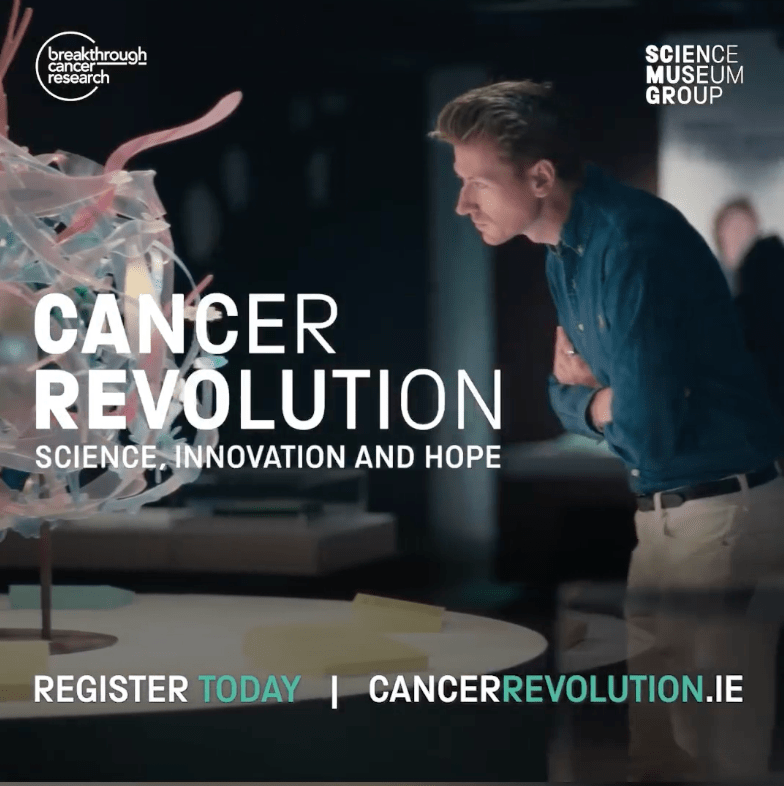
Cancer Revolution Exhibition

WHAT YOU’LL DISCOVER
  • Real stories from people affected by cancer
  • Groundbreaking science that’s shaping the future of treatment
  • Interactive exhibits that let you explore how cancer works
  • The surprising truth about prevention, early detection, and personalised treatment
  • Hope – through the power of research

https://breakthroughcancerresearch.ie/cancer-revolution/

Building Supportive Communities for Patients Navigating Cancer

Key Takeaways
  • Stage 4 cancer patients often find more relevant information from peers than healthcare providers, highlighting the importance of community connections.
  • The cancer community’s collective wisdom aids in finding appropriate care, resources, and support for patients and their families.
  • Despite the loneliness of a cancer diagnosis, being part of a supportive network ensures individuals are never truly alone.
  • The willingness of cancer advocates to share knowledge and resources is invaluable in helping others navigate their diagnosis and treatment journey.

https://www.curetoday.com/view/building-supportive-communities-for-patients-navigating-cancer