Restrictive diets are unnecessary for colonoscopy: Non-inferiority randomized trial

In colonoscopy, preparation is often regarded as the most burdensome part of the intervention. Traditionally, specific diets have been recommended, but the evidence to support this policy is insufficient. The aim of this study was to evaluate the impact of the decision not to follow a restrictive diet on bowel preparation and colonoscopy outcomes.

Conclusions The liberal diet was non-inferior to the 1-day LRD, and increased tolerability. Colonoscopy performance and quality were not affected. 

A non-inferiority randomised trial is a study designed to prove that a new treatment is not worse than an existing treatment by more than a pre-defined, acceptable margin.

A liberal diet isn’t about eating anything you want, but rather following a low-fiber diet for a few days beforehand, gradually transitioning to clear liquids the day before the procedure.

https://pmc.ncbi.nlm.nih.gov/articles/PMC10919995/

Low-dose aspirin can prevent bowel cancer in people with Lynch syndrome

A little dose goes a long way.

CaPP3’s results show that taking as little as 75 to 100mg of aspirin each day can halve the risk of bowel cancer in people with Lynch syndrome, a heritable genetic condition that makes bowel cancer much more likely. The findings mean regulators and doctors should soon be able to recommend a specific low-dose aspirin prescription for people with Lynch syndrome, protecting many more of them from bowel cancer.

https://news.cancerresearchuk.org/2025/06/24/capp3-low-dose-of-aspirin-can-prevent-bowel-cancer-in-people-with-lynch-syndrome/

Lynch Syndrome UK Conference 2025 -Highlights

Below you’ll find short summaries of each talk, with a link to the YouTube recordings on our YouTube channel, as well as links to additional useful resources at the end.

https://www.lynch-syndrome-uk.org/post/lynch-syndrome-conference-2025-highlights

From smart knives to virtual reality tumours: five innovations in understanding cancer

Using virtual reality (VR) coupled with sophisticated imaging and software technologies, scientists will before long be able to step inside interactive maps of patients’ tumours, looking at them in unprecedented detail, and understand better than ever how the cells interact and behave.
And the immersive experience should also open new opportunities for scientific collaboration. Researchers and physicians anywhere in the world could meet in VR spaces to study tumours in ways that simply aren’t possible in 2D.

https://www.cancerresearchhorizons.com/news-and-events/our-articles/smart-knives-virtual-reality-tumours-five-innovations-understanding-cancer

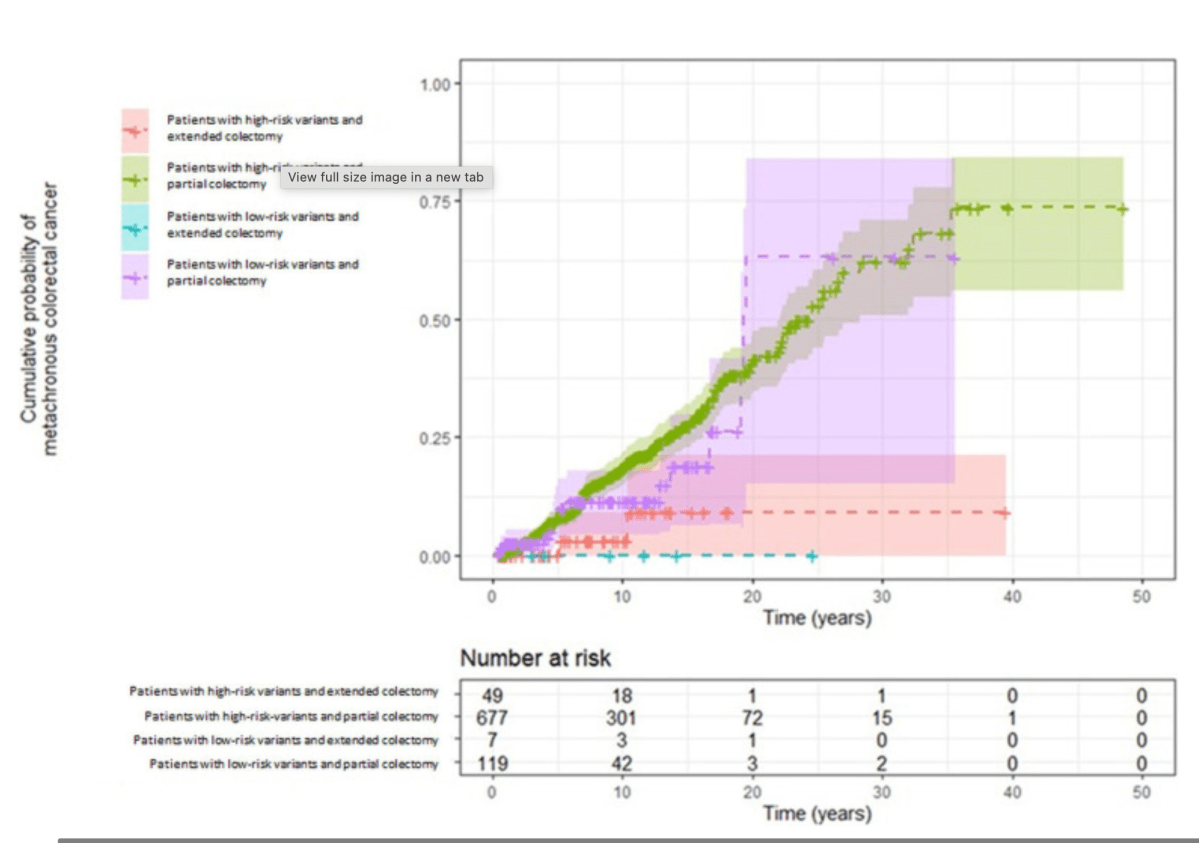
New Insights Into Metachronous Colorectal Cancer Risk in Lynch Syndrome

Background & Aims

Lynch syndrome (LS) is the most common hereditary colorectal cancer (CRC) syndrome. The choice of extended or partial colectomy in patients with LS with primary CRC may influence the risk of metachronous CRC. This study aimed to identify factors associated with metachronous CRC risk and evaluate their potential implications for surgical decision-making.

Metachronous (CRC) is a new, separate primary cancer of the colorectum that develops after a patient has already been diagnosed with and treated for an initial CRC.

Conclusions:

This study identifies important risk factors for metachronous CRC in patients with LS, which may support personalised counseling regarding surgical strategies. The findings highlight the complexity of surgical decision-making and the need for individualised approaches. Further studies are required to refine risk stratification and evaluate long-term outcomes to optimise patient care.

https://www.cghjournal.org/article/S1542-3565(25)00638-X/fulltext

The diagnostic accuracy of the faecal immunochemical test(FIT) for the detection of early-onset colorectal cancer: an age-stratified analysis in South West England

The faecal immunochemical test (FIT) is a diagnostic triage tool for patients presenting with clinical features of CRC in primary care, though its performance in individuals under 50 years is not well established.

Conclusions: FIT performs excellently for patients aged 40-49; however, it may not be used optimally in patients <40 years. A more targeted strategy is needed to guide investigation in younger patients.

https://pubmed.ncbi.nlm.nih.gov/40847011/

Prospective Lynch syndrome database

A prospective Lynch syndrome database is important because it allows researchers, clinicians, and policymakers to collect and analyse long-term, standardised data on people with Lynch syndrome (LS).

(Using Chat GPT)

📌 In short: A prospective Lynch syndrome database is essential because it produces high-quality, unbiased evidence on cancer risks, surveillance effectiveness, and preventive strategies, directly improving patient care and shaping clinical guidelines.

Here are the key reasons why it matters, based only on reliable clinical and research perspectives:

  1. Natural history understanding
    • Prospective data (collected forward in time) helps clarify the true risks of different cancers (colorectal, endometrial, ovarian, gastric, etc.) in Lynch syndrome carriers.
    • It reduces biases compared to retrospective reports, which often overestimate risks due to selective reporting of severe cases.
  2. Better risk stratification
    • Different mismatch repair (MMR) gene variants (MLH1, MSH2, MSH6, PMS2, EPCAM) carry different cancer risks.
    • A prospective database helps define more precise, gene-specific and even sex-specific risk estimates, which guide personalized surveillance.
  3. Evaluation of surveillance effectiveness
    • Prospective registries allow direct measurement of how colonoscopy intervals (e.g., every 1–2 years) affect cancer incidence, stage at diagnosis, and mortality.
    • They can test whether surveillance reduces advanced cancers, enabling evidence-based guideline updates.
  4. Assessment of preventive strategies
    • Allows evaluation of risk-reducing interventions such as aspirin (e.g., CAPP2/CAPP3 trials), prophylactic surgeries, or lifestyle modifications.
    • Can help identify who benefits most from preventive measures.
  5. Improved clinical counseling
    • Physicians and genetic counselors can give patients more reliable, individualized risk information, reducing uncertainty and supporting informed decisions.
  6. Data for health policy
    • National or international databases provide evidence for cost-effectiveness of surveillance and preventive programs.
    • This supports resource allocation and insurance coverage for Lynch syndrome management.
  7. Research opportunities
    • Creates a resource for studying modifiers of cancer risk (genetic, environmental, lifestyle).
    • Enables collaboration across centers and countries for rare cancers within LS populations.

https://plsd.eu

BETWEEN HOPE AND HYPE: WHAT CANCER BLOOD TESTS REALLY MEAN FOR PATIENTS

For us as advocates, the message is clear: celebrate the progress, but guard against the hype. Stories of individual breakthroughs are moving — but without long-term, carefully designed trials that measure not just detection but survival, we risk creating false reassurance or unnecessary harm.

The real “holy grail” is not simply detecting cancer earlier. It is learning to distinguish between cancers that demand urgent treatment and those that do not; between signals of danger and signals of noise. Only then will early detection truly translate into lives saved.

“Patients” are the actual end users of Medical Research.

“Patient” partners improve researcher understanding of the real life priorities and impact of their work.  

Few or no people define or refer to themselves as patients. They understand that a patient is less than a whole person, is less than what they are. I would prefer thinking of ‘people’ engaged in their health and health care.

Patients” can also be experts in the lived experience of their own diagnoses,  who contribute to medical research and education teams as partners in meaningful academic projects.

Bowel Cancer in Ireland: 

Patients, Bowels, Basics, and Breakthroughs
On 11th & 12th September, RSCI is holding a bowel cancer event dedicated to patients, families, and the wider community affected by this cancer. 

PVCR Chair Prof Amanda McCann is leading a session on Friday 12th September at 1:30pm on “The Importance of PPI in Research” with PhD students from ColoMARK and patient advocates from Bowel Cancer Ireland.

There will also be open conversations with doctors, researchers, and experts in fertility, sexual health, and psycho-oncology across the two days. 

You can click here or scan the QR code below to register. Any questions or concerns can be directed to EpiGastroDRG@outlook.com

You can also check out their free bowel cancer informational booklet here or through the QR code below to the right.