Blog

Lynch syndrome cancer vaccines: A roadmap for the development of precision immunoprevention strategies

Safe and effective cancer prevention strategies are critically needed to improve the life quality and longevity of LS and other Hereditary Cancer Syndrome carriers. The era of precision oncology driven by recent technological advances in tumor molecular profiling and a better understanding of genetic risk factors has transformed cancer prevention approaches for at-risk individuals, including LS carriers. 

Here, they discuss recent advances in precision cancer immunoprevention approaches, emerging enabling technologies, research gaps, and implementation barriers toward clinical translation of risk-tailored prevention strategies for LS carriers.

https://www.frontiersin.org/articles/10.3389/fonc.2023.1147590/full#h5

The success of FSP neoantigen(mutation)-based cancer vaccines for LS cancer prevention will hopefully demonstrate the potential marketability of cancer preventive vaccines in the next decade, which will bring an increasing interest from the private sector and can lead to the partnership opportunities between academia, government, and industry for the betterment of quality of life for LS and other high-risk populations.

Mortality by age, gene and gender in carriers of pathogenic mismatch repair gene variants receiving surveillance for early cancer diagnosis and treatment: a report from the prospective Lynch syndrome database

The current study found low CRC mortality in path_MMR carriers who receive colonoscopy surveillance while some extracolonic cancers were associated with high mortality. Further improvement of survival in LS may require a focus on the prevention and treatment of non-colorectal cancers, likely including approaches based upon the immune response to MSI pre-cancerous lesions and cancers.

This study also provides more precise cumulative cancer incidences for path_MMR carriers than have been available previously, stratified by age, gene, organ, and gender.

https://www.sciencedirect.com/science/article/pii/S258953702300086X

What is Lynch Syndrome?

Be aware of gene changes and cancer in your family and take part in screening to reduce your risk of cancer.

https://www.cancer.ie/node/982

Calling on all people with #LynchSyndrome

March 22nd is #LynchSyndromeAwarenessDay Join forces and help make LS visible #LetsGoDotty for Lynch! Take part by wearing something dotty and posting your pics. Together we can make a difference #TeamLynch

Polkadot Dot GIFfrom Polkadot GIFs

“I was told I was too young for it to be that”

https://www.bowelcanceruk.org.uk/how-we-can-help/real-life-stories/younger-people-with-bowel-cancer/tom-bartlett,-oxford/

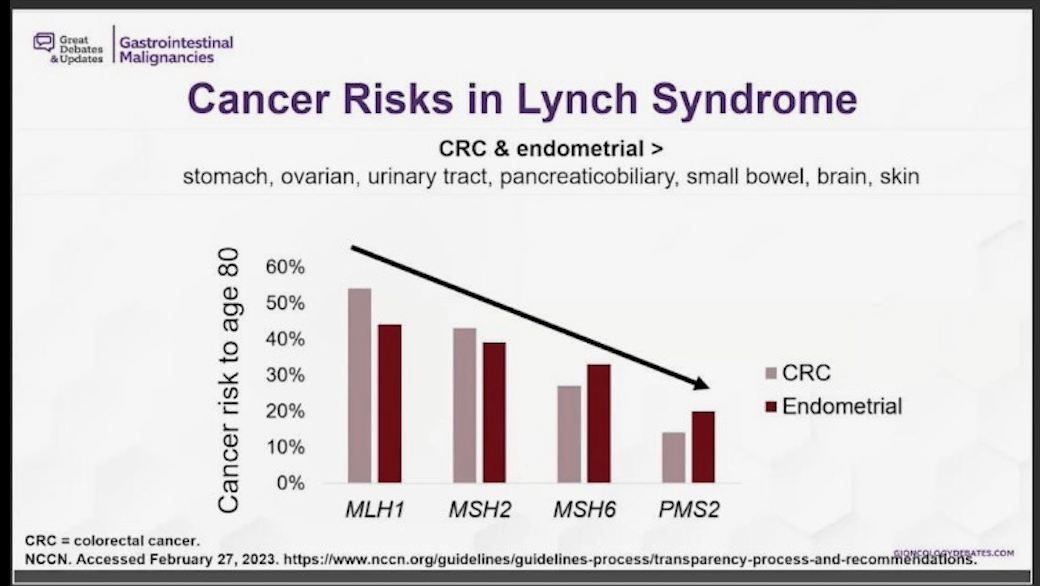
Lynch Syndrome Cancer Risks(to age 70)

Individuals with #LynchSyndrome are at increased risk for multiple cancer types (common ones shown here).

Note: MLH1 has the highest pancreatic cancer risk, MSH2 has the highest urothelial & prostate cancer risk, & PMS2 risks are mainly CRC & EC.

Lynch Syndrome

Individuals with Lynch syndrome can reduce their risk for Colorectal cancer by:

1. Taking daily aspirin (exact dose & duration TBD).

2. Getting colonoscopy every 1-2 y starting at age 20-25 for MLH1/MSH2 & every 1-3y starting at age 30-35 for MSH6/PMS2.

Early-Onset Colorectal Cancer (EOCRC)

Patients with EOCRC have a higher relative prevalence of inherited predisposition to cancer, with Lynch syndrome being the most common cause. 

Colorectal cancer in younger people

Similar factors increase the risk of early-onset colorectal cancer (EOCRC) and later-onset colorectal cancer (LOCRC), such as a sedentary lifestyle, obesity, and metabolic syndrome, but there are also important differences. EOCRC predominantly occurs on the left side of the colon and the rectum, whereas LOCRC arises more commonly on the right side of the colon. EOCRC is also more poorly differentiated and often metastatic at diagnosis.

Research is urgently needed to understand the increasing incidence of EOCRC and its pathophysiology to better detect and treat patients.

Demystifying genomics in cancer care

Cancer is a disease of the genome, caused by unchecked cell growth due to mutations or changes in our DNA. Cancer genomics involves studying the genetic changes in cancer cells, allowing us greater insight into prevention, early detection, treatment, prognosis and recurrence.

In the case of cancer, a change is introduced which causes the cells to multiply uncontrollably – they become cancer cells and allow a cancer to develop. Most of the time these cancer-causing genetic changes are acquired i.e. they occur from damage to genes in a particular cell during a person’s life (also known as sporadic cancer). 

Why does cancer run in families?

Around 5-10% of cancers are caused by inherited or germline changes. This is where a genetic alteration occurs in a sperm or egg cell. It passes from the parent to the child at the time of conception and the alteration in the initial egg or sperm cell is copied into every cell within the body.

As the genetic alteration affects reproductive cells it can pass from parent to child and onwards to subsequent generations. Conditions such as Lynch Syndrome, is an example of an inherited cancer syndrome. This dominantly inherited conditions can greatly increase an individuals risk of developing cancer and mean that there is a 50% (or 1 in 2) chance that a parent can pass the genetic alteration onto their child.

Identifying a person with an inherited form of cancer is important. It means they can be looked after more closely in the future but it also has important implications for the family.

Genomics allows us to develop more precise treatments for cancer. Targeting treatments that focus on a cancer’s genetic makeup rather than where it has grown in the body.

https://www.macmillan.org.uk/healthcare-professionals/news-and-resources/blogs/demystifying-genomics-in-cancer-care