EVERY STORY COUNTS

Especially on World Cancer Day.

Cancer is more than just a medical diagnosis—it’s a deeply personal matter. Behind every diagnosis lies a unique human story – stories of grief, pain, healing, resilience, love and more.

That’s why a people-centred approach to cancer care that fully integrates each individual’s unique needs, with compassion and empathy, leads to the best health outcomes.

Why is it so hard to….TREAT THE PERSON, NOT JUST THE DISEASE.

People living with cancer don’t always feel heard, seen, or understood. They might feel alienated and voiceless at a time when they’re also learning to navigate an unfamiliar and confusing health system, not to mention dealing with the emotional highs and lows of cancer diagnosis, treatment, or recovery.

People-centred cancer care represents an opportunity to refocus, rewire, and rewrite how we think about cancer, to embrace people’s differences, and to make sure that everyone is seen for who they really are and has access to the care they need. 

New report highlights UK-wide picture for people affected by Lynch syndrome

Identifying people with Lynch syndrome has important implications for the person affected, and their family members. It is also a crucial part of the puzzle to improve survival of bowel cancer, through increasing early detection in people with a high risk of developing the disease.

Since 2018, considerable progress has been made, with 90% of UK bowel cancer
patients being tested for Lynch syndrome in 2022/23.
However, significant challenges with testing family members and offering routine surveillance colonoscopies still require urgent attention.


Testing all newly diagnosed bowel cancer patients for Lynch syndrome (also called universal testing) and routine surveillance are vital to meeting the early diagnosis ambitions set out by governments and health services across the UK.

Colonoscopies – Why bother?

It just might save your life.

During my third colonoscopy colon cancer was discovered and it had advanced to my Lymph Nodes. I had no symptoms.

Why was I having colonoscopies? I had a family history of colon cancer and my sibling had tested positive for Lynch syndrome (an inherited predisposition to certain types of cancers including colon and endometrial.

I can understand why many people are nervous about getting colonoscopies. Some wonder how long a colonoscopy will take, how best to prepare for the procedure, how much time you’ll need to take off from work and how embarrassing or disruptive this important cancer screening procedure will be.

Why should people get colon cancer screenings?

The answer is simple: colon cancer screenings can detect colorectal cancer early and prevent unnecessary deaths. Colorectal cancers also are highly preventable and treatable if detected early. In fact, if doctors detect pre-cancerous polyps during a colonoscopy, they can remove the polyps during the procedure.

Prior to Colonoscopy:

Some may think…it’s not pleasant(although having had more than 15 to date I can say I do not find it so, but including the preparation, in most cases you’re spending less than 24 hours to help prevent cancer

Typically, people prepare for a colonoscopy in their homes the day or the night before along with amending their diet for a few days prior to the procedure. The Bowel preparation prescribed — which involves drinking a lot of water along with prep – can take a number of hours . That’s because you’ll be peeing and pooping out all the waste from your body, so you’ll have a clean, empty colon.

Colonoscopy Procedure:

The actual procedure is quick – usually less than 30 minutes. The doctor inserts a scope into your rectum. You are fully sedated prior to the start of the procedure and you wake up after it is over and you usually don’t remember any of the procedure. For nearly everyone, the actual colonoscopy is painless and relatively quick. You wake up, and you’re done. Aside from not being able to drive themselves home from the procedure, most people feel well and are able to eat and drink normally after a colonoscopy.

What are polyps and how common are they?

Polyps are like skin tags that form on the lining of the colon. Some of them are pre-cancerous, which means that over a period of time, they could become cancerous. So, when polyps are found during a colonoscopy, they can easily remove the vast majority of them. That’s how colon cancer is prevented through colonoscopy.”

https://www2.hse.ie/conditions/bowel-screening/colonoscopy-after-bowel-screening/

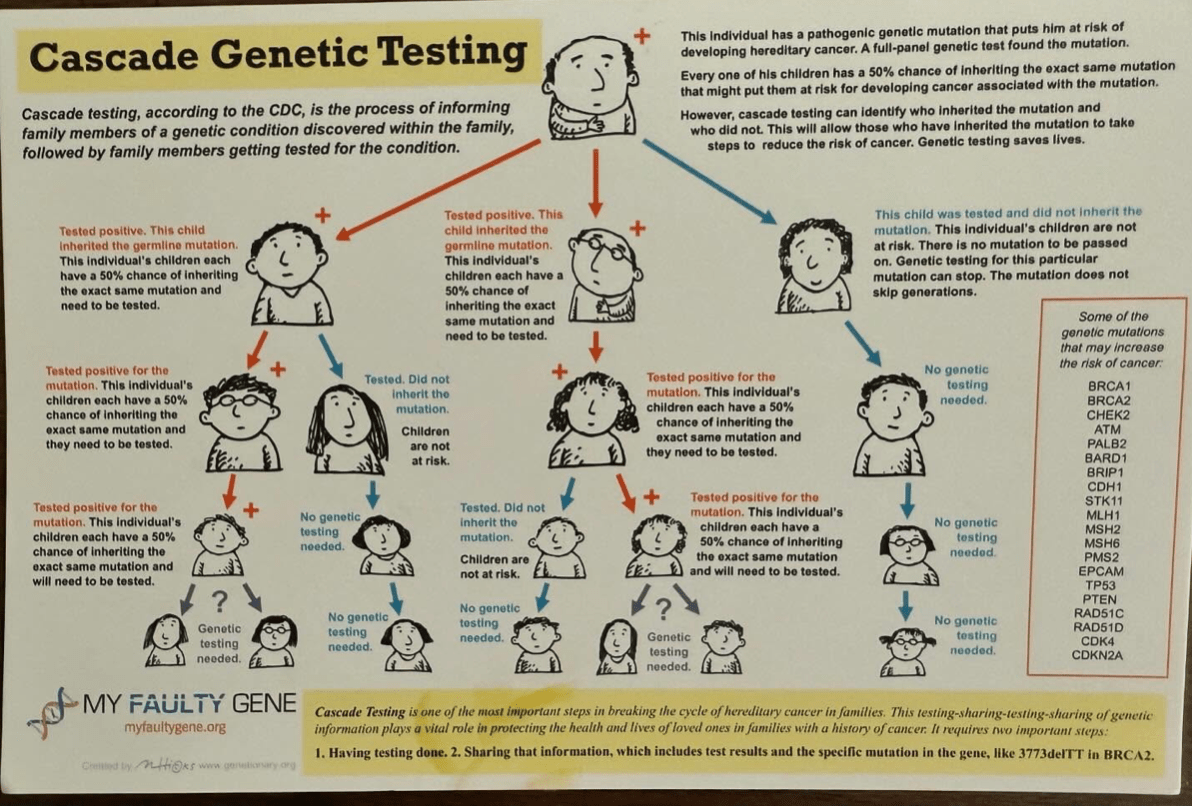
What is Cascade Genetic Testing?

Is the process of informing family members of a genetic condition discovered within the family, followed by family members getting tested for the condition.

It can identify who inherited the mutation and who did not. This will allow those who have inherited the mutation to take steps to reduce the risk of cancer. Genetic testing saves lives.

Cascade Testing is one of the most important steps in breaking the cycle of hereditary cancer in families. This testing-sharing-testing-sharing of genetic information plays a vital role in protecting the health and lives of loved ones in families with a history of cancer.

It requires a number of important steps:

1. Having testing done. 2. Sharing that information, which includes test results and the specific mutation in the gene.

In Lynch syndrome mutations in the following genes may increase the risk of cancer: MLH1, MSH2, MSH6, PMS2 and ЕРСАМ.

New prostate cancer test means some men could avoid unnecessary treatment

30% of patients have an aggressive type of this cancer needing urgent treatment, about 70% have slow-growing cancer and can be monitored without immediate treatment.

This new test was developed out of concerns over-treatment was becoming an issue for men with this type of cancer who may not need treatment. 

https://www.irishexaminer.com/news/arid-41558602.html?fbclid=IwY2xjawIJav1leHRuA2FlbQIxMQABHV–aPM8B4X_2X6JskIYQW7kjzyFYRIGV6VbTNk2DbfSROCumCTCnsOC2g_aem_D-aR8RjS62zVIh3i95144Q

Conclusion: https://bjui-journals.onlinelibrary.wiley.com/doi/10.1002/bco2.474?fbclid=IwY2xjawIJbD1leHRuA2FlbQIxMAABHUSnhz-ugdbis31f1RIiZ29Pfrmoz_JXAWilNVme-L3aFsCA35khswqsMA_aem_30sxxBEWlboKs6aqWleGgA

Biopsy-based MCRS improves risk stratification over standard clinical and pathological information and optimises patient management after diagnosis of prostate cancer.

Primary Care Research into Cancer(PRICAN)

What is PRICAN?

Cancer represents a significant public health challenge in Ireland. Forecasts also indicate a potential doubling of cancer diagnoses between 2010 and 2040, primarily due to an ageing population. 

In recent years, there has been a shift in cancer control strategies towards prioritising prevention and early diagnosis, as the most cost-effective long-term approach to cancer control.

The National Cancer Strategy explicitly calls for an expanded role for general practitioners (GPs) in managing the entire cancer continuum, from prevention and early diagnosis to treatment and ongoing survivor support.

Despite its increasing importance in cancer control, primary care research has historically received less funding compared to laboratory and hospital-based research.

Whilst screening enables early detection of some presymptomatic cancer, approximately 85% of cancers are diagnosed after the onset of symptoms . This fact underscores the importance of equipping primary care with robust clinical guidelines and efficient referral pathways. 

The anticipated rise in cancer incidence demands proactive measures to strengthen the Irish healthcare system. By recognising the critical role of primary care across the cancer care continuum, and adopting a strategic approach to investment in research, Ireland can develop and implement evidence-based policies and strategies. This approach will not only mitigate the impacts of increasing cancer incidence but also position Ireland at the forefront of innovative and effective cancer care.

https://prican.eu

Should HSE hire a team of engineers?

Absolutely.

@mccarthymt7 “If the HSE wants to improve efficiency in the healthcare system, they should hire a team of engineers with medical experience to examine the processes in place in service delivery, and give them the authority to effect changes in service provision that would maximise patient flow. Otherwise, more nurses, more HSCPs, more doctors, and more space to work in would help, and is needed across the board. The imbalance between capacity and demand at the point of provision of care seems glaring to me.”

The very obvious shortages of hospital beds, theatres, diagnostic, and other facilities across the country need to be addressed, together with filling the hundreds of consultant posts that are vacant or filled on a temporary basis.

Adventures of a Sick Doctor

Still Working

I am not actually getting chemo. I am getting cetuximab, which is a monoclonal antibody and therefore known as a targeted therapy, rather than a chemotherapy. 

Collectively, the various gunks that they administer to knobble cancer are called Systemic Anti-Cancer Treatment, or SACT. 

https://adventuresofasickdoctor.blogspot.com/2025/01/still-working.html

The tumour histopathology “glossary” for AI developers

The applications of artificial intelligence (AI) and deep learning (DL) are leading to significant advances in cancer research, particularly in analysing histopathology images for prognostic and treatment-predictive insights.

However, effective translation of these computational methods requires computational researchers to have at least a basic understanding of histopathology. In this work, we aim to bridge that gap by introducing essential histopathology concepts to support AI developers in their research. 

Challenges and outlook

To be implemented into routine practice, an AI algorithm needs several indispensable properties, i.e.,

clinical relevance, high accuracy, rapid implementation, fast computation, and last but not least, user-friendliness.

https://journals.plos.org/ploscompbiol/article?id=10.1371/journal.pcbi.1012708#abstract0