

Be aware of gene changes and cancer in your family and take part in screening to reduce your risk of cancer.
Category: Genetic Testing
“I was told I was too young for it to be that”

Demystifying genomics in cancer care

Cancer is a disease of the genome, caused by unchecked cell growth due to mutations or changes in our DNA. Cancer genomics involves studying the genetic changes in cancer cells, allowing us greater insight into prevention, early detection, treatment, prognosis and recurrence.
In the case of cancer, a change is introduced which causes the cells to multiply uncontrollably – they become cancer cells and allow a cancer to develop. Most of the time these cancer-causing genetic changes are acquired i.e. they occur from damage to genes in a particular cell during a person’s life (also known as sporadic cancer).
Why does cancer run in families?
Around 5-10% of cancers are caused by inherited or germline changes. This is where a genetic alteration occurs in a sperm or egg cell. It passes from the parent to the child at the time of conception and the alteration in the initial egg or sperm cell is copied into every cell within the body.
As the genetic alteration affects reproductive cells it can pass from parent to child and onwards to subsequent generations. Conditions such as Lynch Syndrome, is an example of an inherited cancer syndrome. This dominantly inherited conditions can greatly increase an individuals risk of developing cancer and mean that there is a 50% (or 1 in 2) chance that a parent can pass the genetic alteration onto their child.
Identifying a person with an inherited form of cancer is important. It means they can be looked after more closely in the future but it also has important implications for the family.
Genomics allows us to develop more precise treatments for cancer. Targeting treatments that focus on a cancer’s genetic makeup rather than where it has grown in the body.
Constitutional (germline) vs Somatic (tumour) variants

Constitutional (also known as germline) variants are present in all the body’s cells, including the germ cells, and can therefore be passed on to offspring; somatic variants arise during an individual’s lifetime in tissues other than the germ cells and so are not passed on.
The identification of a germline variant in a mismatch repair (MMR) gene in a patient with colorectal cancer has implications for the clinical management of the current cancer and the patient’s future cancer risk. It should also trigger cascade screening in the wider family.
(Cascade testing is the process of informing family members of a genetic condition discovered within the family, followed by family members getting tested for the condition.)
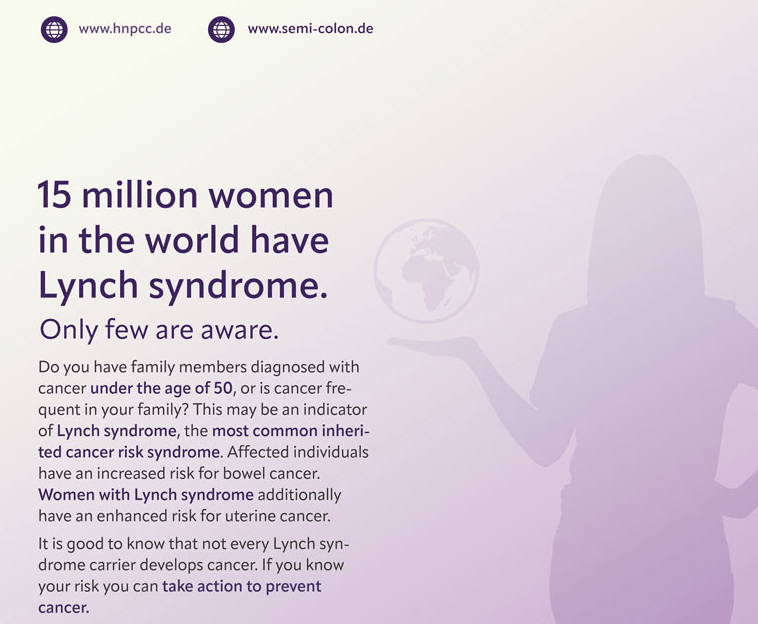
Lynch Syndrome
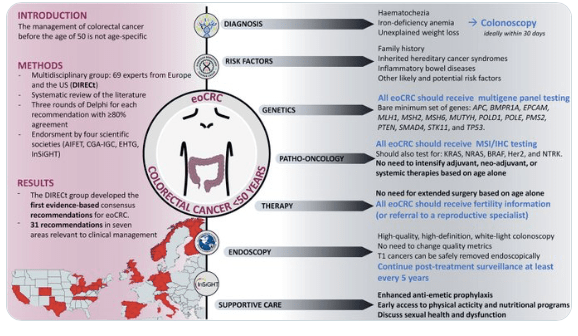
Delphi Initiative for Early-Onset Colorectal Cancer (DIRECt) International Management Guidelines
Conclusions
The DIRECt group produced the first consensus recommendations on eoCRC. All statements should be considered together with the accompanying comments and literature reviews. We highlighted areas where research should be prioritized. These guidelines represent a useful tool for clinicians caring for patients with eoCRC.
Results
The DIRECt consensus produced 31 recommendations for patients diagnosed with eoCRC ≥18 years old based on 145 articles (summarized in Supplementary Appendices 2–7). When appropriate, issues related to colon or rectal cancers specifically are highlighted; in cases where statements applied to both colon and rectal cancer, the term colorectal cancer (CRC) was used.
All statements are summarized in Table 2, Table 3, Table 4(Table 2: diagnosis, risk factors, and genetics; Table 3: pathology, oncology; Table 4: endoscopic diagnosis and treatment, therapy, and supportive care). Areas of controversy are described throughout the main text and summarized in Table 5.
Does Genetic Testing Affect The Cost of Life Insurance in Ireland?

Well, fortunately for you, if you have undergone genetic testing, they don’t, and they can’t add a loading to your policy.
Why can’t insurers use genetic test results?
We all have the Disability Act 2005 to thank.
This pretty sound piece of legislation prohibits the insurance companies from asking about genetic tests.
When you apply for life insurance, you must disclose a certain amount of personal information, such as:
- Family medical history
- Personal medical history – Your insurer may ask for access to your medical records, but you have to provide your permission for this.
- Your age
- Height & weight
- Whether you are a smoker or a drinker
- Any prescription drugs you take
- Your occupation – high-risk occupations can increase your premiums)
- Any hazardous hobbies you take part in
- Star sign
- Pet’s name
- Mother maiden name
- How many photos contain traffic lights
Roberta
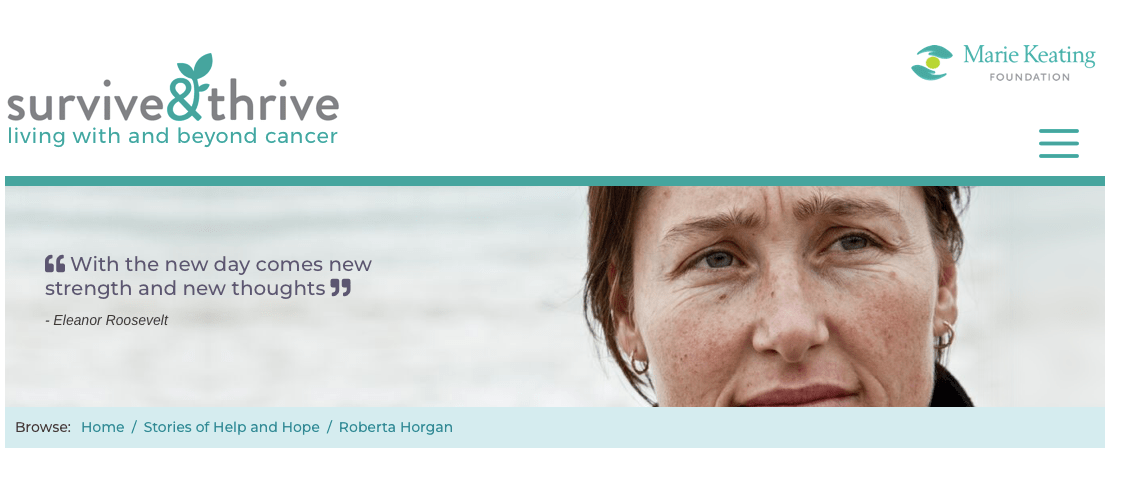
I’ve been given the gift of information,while it can be physically & emotionally taxing, I can take steps to ensure colorectal cancer doesn’t end my life.I can help others have the courage to get tested & go for screening if they notice a change.
When asked what she wanted people to take away from her contribution to the Marie Keating Foundation’s #JoinTheBowelMovement campaign this April, Roberta’s message was simple.
“Firstly, get to know your family history and the signs and symptoms of bowel cancer. Secondly, if you are experiencing symptoms but don’t fit the idea in your mind of “what a bowel cancer patient is”, speak to your GP about it anyway. And finally, if you’re eligible, go for BowelScreen. It’s so much easier to prevent than to cure, so if you were to take something away from my story, I would want it to be that.”
thisisGO – Lynch Syndrome

thisisGO.ie is an online personalised resource for you and yours who have been impacted by a gynaecological cancer.
Also an excellent resource for Lynch Syndrome.
National Nursing Workshops: An introduction to Lynch syndrome & the national Lynch syndrome project(UK)

These workshops are aimed at nurses looking for an introduction to Lynch syndrome and the project, and will cover the basics.
 Lynch Syndrome Ireland