
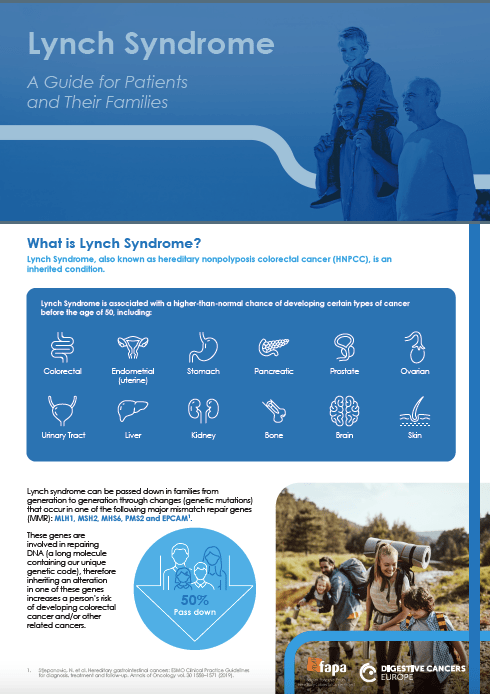
A Guide for Patients and Their Families
Lynch Syndrome is associated with a higher-than-normal chance of developing certain types of cancer before the age of 50.
What does it mean to live with Lynch Syndrome?
A Guide for Patients and Their Families
Lynch Syndrome is associated with a higher-than-normal chance of developing certain types of cancer before the age of 50.
What does it mean to live with Lynch Syndrome?
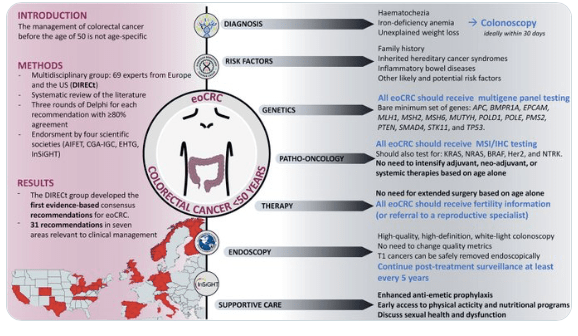
The DIRECt group produced the first consensus recommendations on eoCRC. All statements should be considered together with the accompanying comments and literature reviews. We highlighted areas where research should be prioritized. These guidelines represent a useful tool for clinicians caring for patients with eoCRC.
The DIRECt consensus produced 31 recommendations for patients diagnosed with eoCRC ≥18 years old based on 145 articles (summarized in Supplementary Appendices 2–7). When appropriate, issues related to colon or rectal cancers specifically are highlighted; in cases where statements applied to both colon and rectal cancer, the term colorectal cancer (CRC) was used.
All statements are summarized in Table 2, Table 3, Table 4(Table 2: diagnosis, risk factors, and genetics; Table 3: pathology, oncology; Table 4: endoscopic diagnosis and treatment, therapy, and supportive care). Areas of controversy are described throughout the main text and summarized in Table 5.
I’ve been given the gift of information,while it can be physically & emotionally taxing, I can take steps to ensure colorectal cancer doesn’t end my life.I can help others have the courage to get tested & go for screening if they notice a change.
When asked what she wanted people to take away from her contribution to the Marie Keating Foundation’s #JoinTheBowelMovement campaign this April, Roberta’s message was simple.
“Firstly, get to know your family history and the signs and symptoms of bowel cancer. Secondly, if you are experiencing symptoms but don’t fit the idea in your mind of “what a bowel cancer patient is”, speak to your GP about it anyway. And finally, if you’re eligible, go for BowelScreen. It’s so much easier to prevent than to cure, so if you were to take something away from my story, I would want it to be that.”
I hope will put a Lynch Syndrome diagnosis in the proper perspective and keep you and your loved ones alive.
First, do not bury your head in the sand…
If you have a family history of cancer–of the uterus, ovaries, bladder, ureter, kidney, stomach, small intestine, liver, pancreas, prostate, and oil glands (there may be others), take seriously the possibility that there is a hereditary component to such histories.
Especially–I repeat ESPECIALLY–if there’s a family history of colon or uterine cancer at a young age, talk to your doctors and get tested for Lynch.
And if you happen to test positive for the Lynch mutation, don’t hide it from your family. Because sharing that information may save others in your family as well.
Second, if you discover that you or a loved one has Lynch Syndrome, DON’T FREAK OUT!
https://frankjpeter.com/category/cancer/
Realise that such knowledge—as upsetting as it—invites you to design a surveillance program with your doctors that will enable you to “stay ahead” of the most common types of Lynch cancers, and thus to swing your odds of living a relatively healthy life hugely in your favor.
Results
Recommendations for clinical and molecular identification of Lynch syndrome, surgical and endoscopic management of Lynch syndrome‐associated colorectal cancer, and preventive measures for cancer were produced. The emphasis was on surgical and gastroenterological aspects of the cancer spectrum. Manchester consensus guidelines for gynaecological management were endorsed. Executive and layperson summaries were provided.
Conclusion
The recommendations from the EHTG and ESCP for identification of patients with Lynch syndrome, colorectal surveillance, surgical management of colorectal cancer, lifestyle and chemoprevention in Lynch syndrome that reached a consensus (at least 80 per cent) are presented.
https://academic.oup.com/bjs/article/108/5/484/6287132?login=false
thisisGO.ie is an online personalised resource for you and yours who have been impacted by a gynaecological cancer.
Also an excellent resource for Lynch Syndrome.
These workshops are aimed at nurses looking for an introduction to Lynch syndrome and the project, and will cover the basics.
Lynch Syndrome is an inherited condition that increases your risk of developing some cancers, including bowel, womb and ovarian cancer. We have developed a guide to run through everything you need to know about Lynch.
This guide has been made with input from experts, people with Lynch Syndrome and our Ask Eve nurses to provide you with all the information you need when offered testing for, or navigating a diagnosis of, Lynch Syndrome.
We also have an Easy Read guide to Lynch Syndrome, which you can download here
Lynch Syndrome
Lynch syndrome (LS) is associated with varying cancer risks depending on which of the five causative genes harbors a pathogenic variant; however, lifestyle and medical interventions provide options to lower those risks.
“We developed MyLynch, a patient-facing clinical decision support (CDS) web application that applies genetically-guided personalized medicine (GPM) for individuals with LS. MyLynch informs LS patients of their personal cancer risks, educates patients on relevant interventions, and provides patients with adjusted risk estimates depending on the interventions they choose to pursue. MyLynch can improve risk communication between patients and providers while also encouraging communication among relatives with the goal of increasing cascade testing. As genetic panel testing becomes more widely available, GPM will play an increasingly important role in patient care, and CDS tools offer patients and providers tailored information to inform decision-making. MyLynch provides personalised cancer risk estimates and interventions to lower these risks for patients with LS.”
https://www.mdpi.com/2072-6694/15/2/391
“The MyLynch risk estimates and their clinical utility should be validated on larger samples of patients in future studies. We also plan to produce a mobile compatible version of the app as well as incorporate risk uncertainty into the estimates.”
Gynaecological cancers refer to any cancer of the female reproductive system which includes the uterus (womb), the ovaries, the cervix (the neck of the womb), the vulva (the outer part of the female genitals) or the vagina.
Ovarian cancer and was launched in February 2022 and the genetic conditions, BRCA and Lynch Syndrome, were added in May 2022. Uterine cancer went live in September 2022. Vulva cancer and vaginal cancer will be live before the end of 2022.
Just log on to https://thisisgo.ie and select “My Profile”





 Lynch Syndrome Ireland