EVERY STORY COUNTS

Especially on World Cancer Day.

Cancer is more than just a medical diagnosis—it’s a deeply personal matter. Behind every diagnosis lies a unique human story – stories of grief, pain, healing, resilience, love and more.

That’s why a people-centred approach to cancer care that fully integrates each individual’s unique needs, with compassion and empathy, leads to the best health outcomes.

Why is it so hard to….TREAT THE PERSON, NOT JUST THE DISEASE.

People living with cancer don’t always feel heard, seen, or understood. They might feel alienated and voiceless at a time when they’re also learning to navigate an unfamiliar and confusing health system, not to mention dealing with the emotional highs and lows of cancer diagnosis, treatment, or recovery.

People-centred cancer care represents an opportunity to refocus, rewire, and rewrite how we think about cancer, to embrace people’s differences, and to make sure that everyone is seen for who they really are and has access to the care they need. 

No other landscape in medicine has changed as drastically as the field of Clinical Genetics – Is Ireland behind the curve?

Advances in technology have been a major driver of the explosion of knowledge in genetics, now allowing us to sequence the entire human genome in a short period of time and at a fraction of the cost of previous years.

This has led to a better understanding of the natural history of cancer, the ability to assess genetic risk for cancer across populations, the development of clinical management strategies to reduce cancer risk, the development of novel therapeutic agents which target genetic alterations, and to improved education of patients and providers about genetic risk.

Hereditary cancer is hard enough to navigate, so we are thankful for patient-friendly information to help inform the decision-making process.

https://www.stjames.ie/cancer/yourtreatmentandcare/servicesandtreatments/cancergeneticsservice/

Genetic testing is a vital tool in enabling individuals to be proactive in their health care to achieve the best possible outcomes.

It’s very important for everyone to understand their cancer risks based on their personal or family history since their personal risk level may necessitate earlier, more frequent, and/or more intensive cancer surveillance.

This is the best way to ensure that you are doing everything you can to prevent cancer or catch it early when treatment has the best outcome.

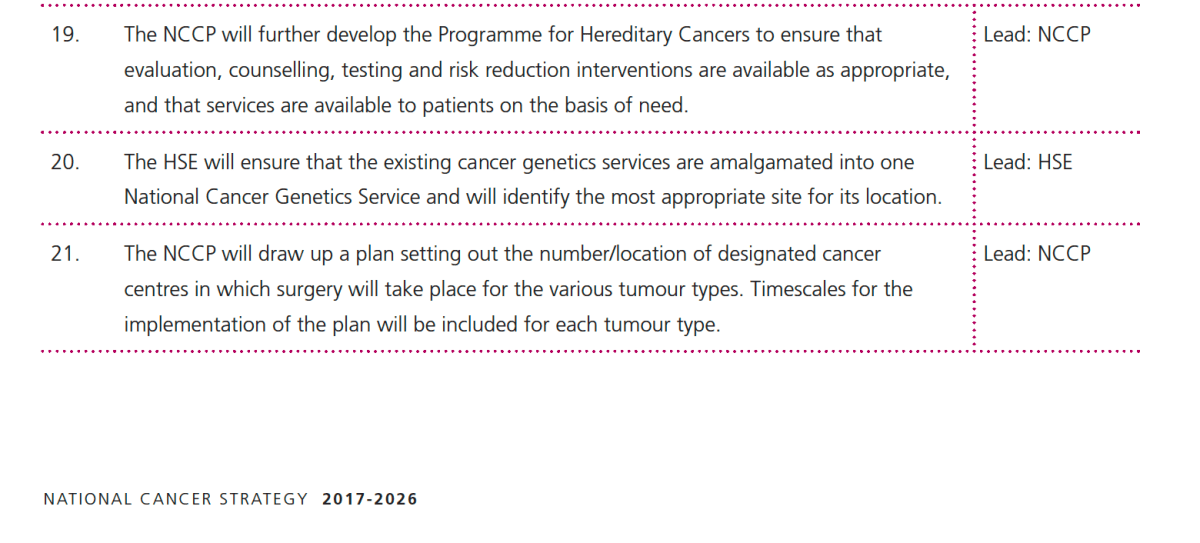
At present cancer genetics services in Ireland are underdeveloped and underfunded. Only a fraction of staff required are in place. As a result long waiting times, extra cost to the state because cancers are not prevented and discovered at a later stage.

More Evidence that Molecular Residual Disease Monitoring Could Guide Adjuvant Therapy in Colorectal Cancer

Studies have found that the ctDNA blood test can reliably detect “molecular residual disease” (MRD) – essentially, small traces of cancer left after surgery. Patients who test positive for MRD have a higher risk of their cancer returning.

In colorectal cancer, circulating tumour DNA (ctDNA) has become a minimally invasive and dependable prognostic biomarker for identifying post-surgical MRD and assessing the risk of recurrence.

In a recent update from the CIRCULATE-Japan GALAXY observational study, results reinforced previous studies demonstrating that monitoring ctDNA can help detect MRD and assess the risk of recurrence in patients with resectable CRC. 

https://news.cancerconnect.com/colon-cancer/more-evidence-that-molecular-residual-disease-monitoring-could-guide-adjuvant-therapy-in-colorectal-cancer-

Dismantling the fallacies of the illness blame-game

A person’s likelihood of succumbing to a particular illness has very little, statistically, to do with how much broccoli they ate in their teens or how many press-ups they do every morning. The concept of the social determinants of health has become more mainstream in recent years, but I think we are still slow to accept how limited conventional medical treatment is when it comes to really making a bottom-line difference to people’s wellbeing.

Becoming agents for genomic change: genetic counsellors’ views of patient care and implementation influences when genomics is mainstreamed

Genetic counsellors are increasingly transitioning beyond clinical genetics services to meet the growing demands for genomic healthcare.

Challenges included hesitancy of some medical specialists regarding the value of genomics in healthcare and potential tension arising from distinct perspectives and practice between genetic and non-genetic professionals.

https://www.nature.com/articles/s41431-024-01686-9

How I Truly Learned to Live With Stage 4 Colon Cancer

How do you live when you are constantly trying to figure out how not to die?

In the face of cancer, those who come before me have shown me how to live each day knowing it could very well be their last. It’s cliche, but it’s true.

None of us are given a timeline or know when we will no longer be a citizen of this world.

https://www.curetoday.com/view/how-i-truly-learned-to-live-with-stage-4-colon-cancer

Find Cancer Early

HSE’s Talking Health and Wellbeing podcast, Dr. Heather Burns discusses the importance of symptom awareness and early detection of cancer. Dr. Burns is a Consultant in Public Health Medicine and Public Health Lead for Early Detection of Cancer with the HSE National Cancer Control Programme. She notes that cancer is common in Ireland, with 1 in 2 people having a cancer diagnosis in their lifetime.

https://www.podbean.com/ew/pb-s2r93-15a9de0

Early treatment discontinuation in patients with deficient mismatch repair or microsatellite instability high metastatic colorectal cancer receiving immune checkpoint inhibitors

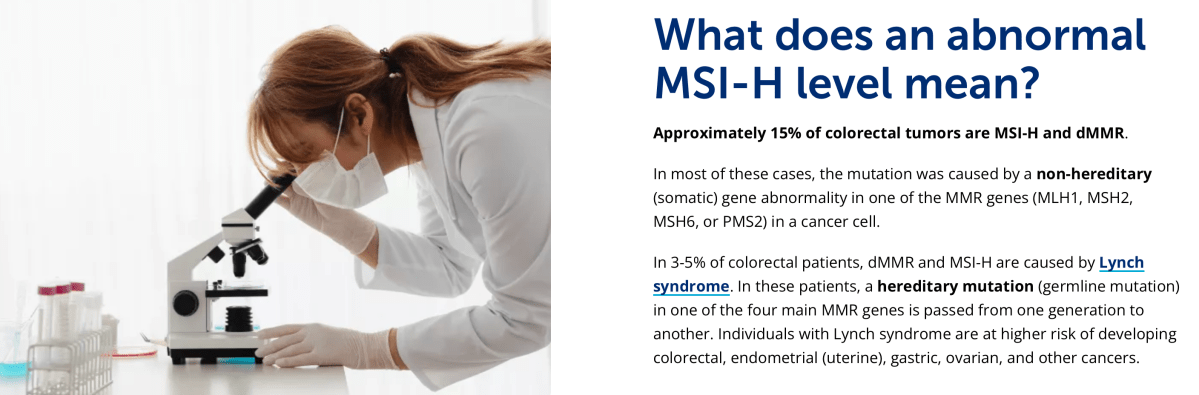
Background Immune checkpoint inhibitors (ICIs) are recommended to treat patients with deficient mismatch repair/microsatellite instability high (dMMR/MSI-H) metastatic colorectal cancer (mCRC). Pivotal trials have fixed a maximum ICI duration of 2 years, without a compelling rationale. 

Conclusions In our international series of dMMR/MSI-H mCRC, early treatment discontinuation of ICIs in the absence of progressive disease can lead to similar long-term disease control compared with a longer treatment duration did not seem detrimental in terms of progression-free survival  and overall survival  compared with continuing treatment beyond 1 year. Randomized clinical trials to compare short and long treatment duration are now warranted.

https://jitc.bmj.com/content/13/1/e010424

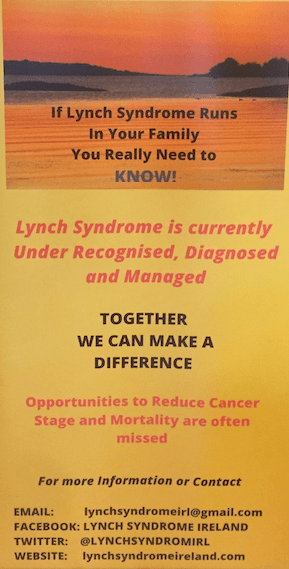
How does Lynch syndrome affect my family?

Genes are inherited in pairs. You inherit one from your mother and one from your father. If someone has Lynch syndrome, one copy of a mismatch repair (MMR) gene is altered and is not working properly. A mismatch gene is a gene involved in making repairs to errors in DNA. If a parent has Lynch syndrome, they can pass the affected gene on to their children. This means that each of their children have a 1 in 2 chance of also having Lynch syndrome.

Knowing this information means you can take steps to reduce your risk of developing cancer. Ask your healthcare provider about where you can get support to talk to your family.