
Blog

Cancer: A word to dread, to not fear and NEVER to celebrate

Those of us going through or have gone through cancer can’t escape the utter dread you feel when that medical person tells you to your face you have cancer. Regardless of the type or severity of cancer, you hear that word in your ears, you feel that word enter your body, mind and psyche, your world stops. Your mind goes blank.
My progress and response to my ongoing treatment for inoperable prostate cancer has been extremely encouraging. I hope to be given great news around the second anniversary of my diagnosis next October. It’s by no means a given. I must stay focussed and positive. And I will. I am grateful for all I have despite that life-changing day nineteen months ago.
Cancer is a fucking curse. Cancer is a wrecking ball, physically and mentally. Be grateful if it never comes to your door. Be better in life. We’re not perfect, we all do and say stupid things, so we can all be better. But be better.
CanChoose
NCCP calls for more ‘in-house’ compounding of anti-cancer therapies

“Building greater resilience in hospitals can be achieved by increasing in-house compounding of SACT(Systemic Anti-Cancer Therapy) within dedicated aseptic compounding units (ACUs)”.
This “helps mitigate the risks associated with relying on outsourced supply chains, which are often fragile and vulnerable to disruptions”.
@mcacrthymt7 “The advantage of on-site compounding is that dose changes or treatment change decisions can be made in real time. Outsourcing to private companies in most cases means ordering SACT 2 weeks in advance. It increases inflexibility in the system. The objective should be to increase efficiency. Maximise onsite SACT compounding.”
Evaluation of user experiences, perceptions and attitudes towards faecal immunochemical testing (FIT) for risk-stratified colonoscopy in people with Lynch syndrome

Objective: This study evaluates the experiences, perceptions, and attitudes of people with Lynch syndrome (LS) towards faecal immunochemical testing (FIT) as an adjunct to colonoscopy for colorectal cancer surveillance.
Conclusions: FIT is widely perceived as an acceptable supplemental tool among surveyed people with LS, who appreciate its potential to reduce intervals between colonoscopies without compromising surveillance quality.
Ongoing patient engagement is crucial to addressing concerns about FIT’s reliability. Future research should evaluate long-term outcomes and explore diverse population perspectives to guide FIT implementation in LS surveillance.
Outcomes with immunotherapy between Lynch syndrome vs non-Lynch syndrome microsatellite instability-high colorectal cancer.

Conclusions: In this study, we found that patient treated with ICIs have similar outcomes in the presence of germline vs. somatic MMR mutations in MSI-H CRC. The presence of an associated BRAF V600E mutation, which occurs in non-LS MSI-H CRC conferred worse outcomes.
https://ascopubs.org/doi/10.1200/JCO.2024.42.3_suppl.175
Immunotherapy increases the body’s ability to identify and attack these cells, and cancers that have high microsatellite instability actually help this effort. As the cells continue to mutate and replicate DNA several times, they create more and more proteins that the body doesn’t recognise as normal.
Before immunotherapy, MSI used to be very bad news for patients with advanced cancers. Because they can mutate rapidly, cancer cells can begin to differentiate from each other and change significantly. Cancer can, for example, gain the ability to metastasize to a different organ or better evade the immune system. With advances in immunotherapy, that prognosis is changing, but that is a very recent shift in just the last few years. Now we know that if you have cancer with MSI, even if it’s late stage, it has a good chance of responding to immunotherapy.
Cancer treatment in the last 6 months of life: when inaction can outperform action

The implications of the decision to treat a terminally ill patient are multidimensional, but the ultimate goal should be to help patients with a peaceful life-death transition.
To that end, education and training of oncologists on end of life care, managing expectations of patients and communication skills are important, as is the role of the media in promoting the importance and complexities of navigating quality end of life care and discouraging the ‘war’ metaphor for cancer.
It is also the case that prescribing drugs in the last 6 months of life constitutes a substantial proportion of total healthcare costs, and we may be able to avoid some of these costs if patients better understand the benefit/risk trade-off offered by anticancer drugs tested in this population.
Yes, I still think about cancer every day!

“There is wisdom in survival. There is wisdom in grief, in forgiveness, in having lived through things that could have broken me. That wisdom doesn’t belong in a drawer. It belongs in the world, where it might do some good.”
Cancer treatment is hard. Life when active treatment ends can be harder. In other words, the work continues. We all do this work and incorporating differently.
NCCP launches three HSE National Clinical Guidelines
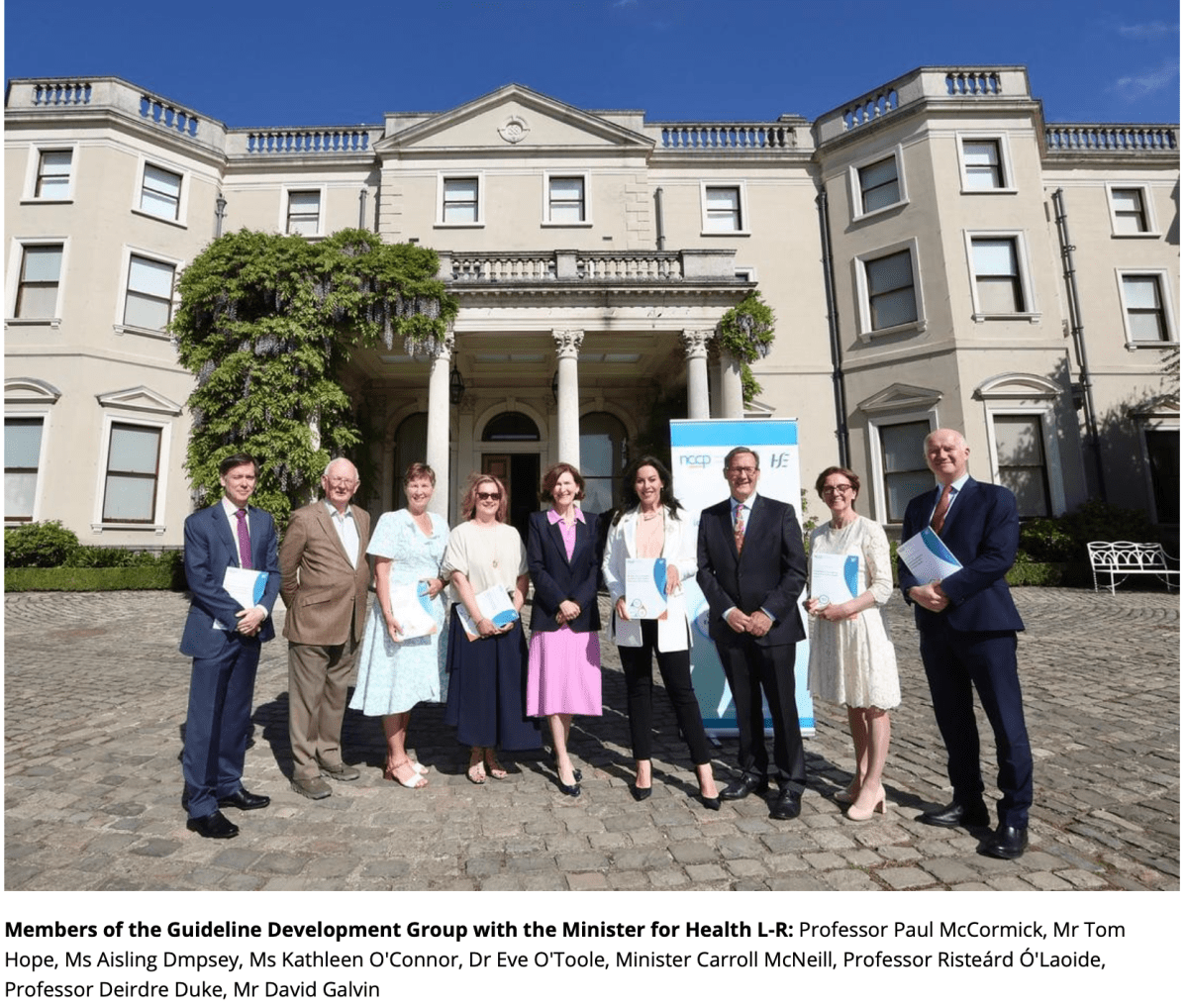
The previous and current National Cancer Strategies recommend that the NCCP develop guidelines for cancer care to improve the quality of care delivered to patients.
To date, nine national clinical guidelines for cancer have been developed, with various updates throughout the years and further updates to continue.
National Clinical Guidelines play a pivotal role in shaping cancer care. They offer patient-centred, evidence-based recommendans that enhance the quality of care provided to patients. They also empower patients to actively participate in decisions relating to their care.
The NCCP recognises the importance of patient input and their role as key stakeholders in developing guidelines. Several patients were invited to contribute to the development of these guidelines which has helped to capture important quality of life issues and patient values.
The guidelines are intended for use by all healthcare professionals involved in multiple stages of the cancer pathway for the three most common cancers in Ireland. They will also be of interest to patients undergoing diagnosis, staging and treatment of these cancers, and their families and carers.
Awash in a Sea of Cancer Misinformation

Experts warn a lot of the information patients encounter online could do much more harm than good
Just because a post has a lot of views or likes, doesn’t mean the information it contains is accurate. In fact, the opposite may be true.
The internet is full of posts and sites designed to sell supplements or other products that supposedly treat or prevent cancer. In that case, a patient may spend hundreds or even thousands of dollars on unproven, often useless products, but there are other, more serious risks to following bad information online.
To get the most current and accurate information pertaining to your unique diagnosis, you should turn first and often to the medical professionals on your cancer care team.

