Delphi Initiative for Early-Onset Colorectal Cancer (DIRECt) International Management Guidelines

Conclusions

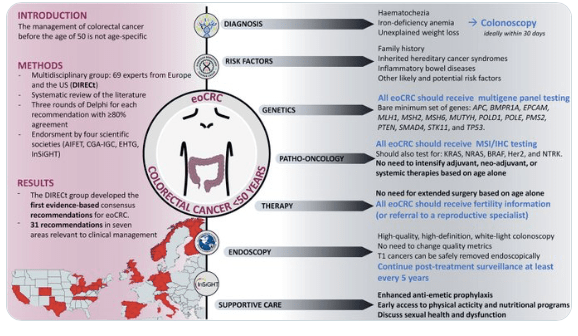
The DIRECt group produced the first consensus recommendations on eoCRC. All statements should be considered together with the accompanying comments and literature reviews. We highlighted areas where research should be prioritized. These guidelines represent a useful tool for clinicians caring for patients with eoCRC.

Results

The DIRECt consensus produced 31 recommendations for patients diagnosed with eoCRC ≥18 years old based on 145 articles (summarized in Supplementary Appendices 2–7). When appropriate, issues related to colon or rectal cancers specifically are highlighted; in cases where statements applied to both colon and rectal cancer, the term colorectal cancer (CRC) was used.

All statements are summarized in Table 2Table 3Table 4(Table 2: diagnosis, risk factors, and genetics; Table 3: pathology, oncology; Table 4: endoscopic diagnosis and treatment, therapy, and supportive care). Areas of controversy are described throughout the main text and summarized in Table 5.

http://ow.ly/ugCX50N1g1L

Womb Cancer Genomics – Research and Patient Benefit

Peaches Womb Cancer Trust is proud to present part one of their womb cancer genomics webinar. Originally aired in November 2022.

With Dr Neil Ryan, who shares his wealth of expertise in Lynch Syndrome.

Note: Can be viewed on You Tube

For more information on the topics discussed, please visit:

https://peachestrust.org/

https://peachestrust.org/peaches-pati…

https://www.lynch-syndrome-uk.org/

https://www.genomicsengland.co.uk/

Does Genetic Testing Affect The Cost of Life Insurance in Ireland?

Well, fortunately for you, if you have undergone genetic testing, they don’t, and they can’t add a loading to your policy.

Why can’t insurers use genetic test results?

We all have the Disability Act 2005 to thank.

This pretty sound piece of legislation prohibits the insurance companies from asking about genetic tests.

When you apply for life insurance, you must disclose a certain amount of personal information, such as:

  • Family medical history
  • Personal medical history – Your insurer may ask for access to your medical records, but you have to provide your permission for this.
  • Your age
  • Height & weight
  • Whether you are a smoker or a drinker
  • Any prescription drugs you take
  • Your occupation – high-risk occupations can increase your premiums)
  • Any hazardous hobbies you take part in
  • Star sign
  • Pet’s name
  • Mother maiden name
  • How many photos contain traffic lights

Can You Get Life Insurance After Cancer?

Yes, it is possible to get life insurance after a cancer diagnosis. However, the availability and terms of coverage will depend on the specific details of your diagnosis, treatment, current health status and family history.

There’s no getting around the fact that life insurance after cancer is more expensive. If you can get cover, the insurer will increase your premium significantly compared to someone with no history of health issues.

Normally this increase will be temporary for a period of between one to ten years.

Roberta

I’ve been given the gift of information,while it can be physically & emotionally taxing, I can take steps to ensure colorectal cancer doesn’t end my life.I can help others have the courage to get tested & go for screening if they notice a change.

When asked what she wanted people to take away from her contribution to the Marie Keating Foundation’s #JoinTheBowelMovement campaign this April, Roberta’s message was simple.

Firstly, get to know your family history and the signs and symptoms of bowel cancer. Secondly, if you are experiencing symptoms but don’t fit the idea in your mind of  “what a bowel cancer patient is”, speak to your GP about it anyway. And finally, if you’re eligible, go for BowelScreen. It’s so much easier to prevent than to cure, so if you were to take something away from my story, I would want it to be that.”

Immunotherapy and… Nothing Else? Studies Test Potential Paradigm Shift in Cancer Treatment

The leaders of those trials and other experts stressed that much more research is needed before this treatment approach becomes part of everyday cancer care. But they agreed that the findings so far are highly encouraging.

The most recent results come from a 35-patient clinical trial conducted at MD Anderson Cancer Center. Most patients in the trial had locally advanced colorectal cancer. Perhaps most important, however, was that all participants’ tumors had specific genetic changes—known as MSI-high or dMMR—that make them particularly good candidates for immunotherapy.

Review of governance arrangements to support HSE drug reimbursement process

The Report concluded that there is scope for improvements in a number of areas, including:

  • transparency of the process
  • communications with, and the availability of, information to patients
  • tracking the progression of medicines through the process

The Minister for Health fully supports any recommendations contained in the Report that improve the process, provide easier access, and support value for money.

Speaking on the publication of the report, Derick Mitchell IPPOSI CEO stated that ‘although long overdue, the publication of this report is an important step in the reform of our medicines access process in Ireland.  The report findings are sensible and practical, and need consideration in the Irish context.  The fact that many other countries, including our near neighbours in Scotland, have many of these reforms already in place is a cause for concern for many patient groups’, he said.

IPPOSI looks forward to engaging with the new working group in 2023 as part of its consultation with patient groups. 

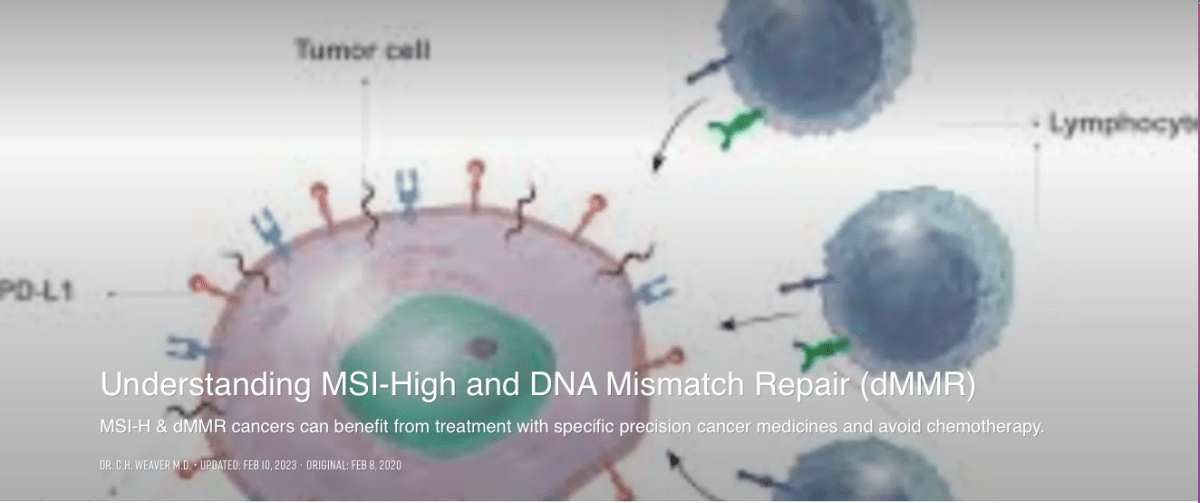
Understanding MSI-High and DNA Mismatch Repair (dMMR)

MSI-H and Lynch Syndrome

Microsatellite instability which is caused by deficiency of the DNA MMR system is the molecular abnormality observed in tumors associated with Lynch syndrome. Lynch syndrome represents one of the most frequent conditions of cancer predisposition in human, thus requiring specific care and genetic counseling.

Detection of MSI is important because MSI is the biomarker that identifies cancers more likely to respond to treatment with precision cancer medicines known as PD-1 immune checkpoint inhibitors. 

https://news.cancerconnect.com/colon-cancer/understanding-msi-high-and-dna-mismatch-repair

A Cancer Journey: My Lynch Syndrome

 I hope will put a Lynch Syndrome diagnosis in the proper perspective and keep you and your loved ones alive.

First, do not bury your head in the sand…

If you have a family history of cancer–of the uterus, ovaries, bladder, ureter, kidney, stomach, small intestine, liver, pancreas, prostate, and oil glands (there may be others), take seriously the possibility that there is a hereditary component to such histories.

Especially–I repeat ESPECIALLY–if there’s a family history of colon or uterine cancer at a young age, talk to your doctors and get tested for Lynch.

And if you happen to test positive for the Lynch mutation, don’t hide it from your family. Because sharing that information may save others in your family as well.


Second, if you discover that you or a loved one has Lynch Syndrome, DON’T FREAK OUT!

https://frankjpeter.com/category/cancer/

Realise that such knowledge—as upsetting as it—invites you to design a surveillance program with your doctors that will enable you to “stay ahead” of the most common types of Lynch cancers, and thus to swing your odds of living a relatively healthy life hugely in your favor.