Primary Care Research into Cancer(PRICAN)

What is PRICAN?

Cancer represents a significant public health challenge in Ireland. Forecasts also indicate a potential doubling of cancer diagnoses between 2010 and 2040, primarily due to an ageing population. 

In recent years, there has been a shift in cancer control strategies towards prioritising prevention and early diagnosis, as the most cost-effective long-term approach to cancer control.

The National Cancer Strategy explicitly calls for an expanded role for general practitioners (GPs) in managing the entire cancer continuum, from prevention and early diagnosis to treatment and ongoing survivor support.

Despite its increasing importance in cancer control, primary care research has historically received less funding compared to laboratory and hospital-based research.

Whilst screening enables early detection of some presymptomatic cancer, approximately 85% of cancers are diagnosed after the onset of symptoms . This fact underscores the importance of equipping primary care with robust clinical guidelines and efficient referral pathways. 

The anticipated rise in cancer incidence demands proactive measures to strengthen the Irish healthcare system. By recognising the critical role of primary care across the cancer care continuum, and adopting a strategic approach to investment in research, Ireland can develop and implement evidence-based policies and strategies. This approach will not only mitigate the impacts of increasing cancer incidence but also position Ireland at the forefront of innovative and effective cancer care.
https://prican.eu

Should HSE hire a team of engineers?

Absolutely.

@mccarthymt7 “If the HSE wants to improve efficiency in the healthcare system, they should hire a team of engineers with medical experience to examine the processes in place in service delivery, and give them the authority to effect changes in service provision that would maximise patient flow. Otherwise, more nurses, more HSCPs, more doctors, and more space to work in would help, and is needed across the board. The imbalance between capacity and demand at the point of provision of care seems glaring to me.”

The very obvious shortages of hospital beds, theatres, diagnostic, and other facilities across the country need to be addressed, together with filling the hundreds of consultant posts that are vacant or filled on a temporary basis.

EPI what?

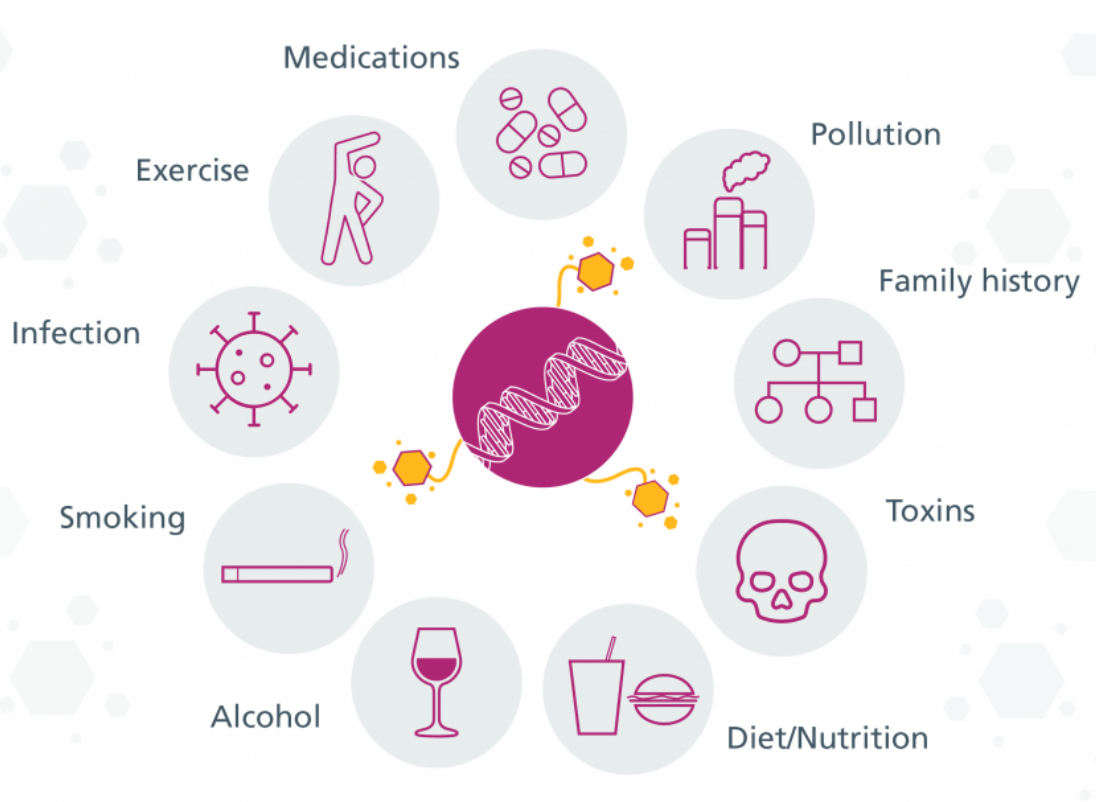
Epigenetics: Is a way of influencing how our genome is regulated without the DNA code itself being changed. Epigenetics can determine when genes are turned on and off (also referred to as gene expression), and which proteins are produced as a result. It can even control the structure of the genome, relaxing the tightly packed chromosomes to allow the factors which control gene expression access to the genes within.

One example of an epigenetic modification is methylation, which is associated with switching genes off. Here, a chemical called a methyl group attaches to a region near the start of a gene and prevents it from being switched on.

Lynch syndrome also illustrates the significance of the epigenetic component in cancer development. Inactivation of tumor suppressor genes by epigenetic mechanisms is an acquired property of many tumors developing in Lynch syndrome.

https://www.genomicseducation.hee.nhs.uk/education/core-concepts/what-is-epigenetics/

Know your family history

Many men with cancer in the family worry that they are at greater risk of getting it themselves. But this isn’t the case for most people. Cancer is a common disease among older people, so most families will include at least one person who has had cancer.

The more relatives who have had cancer, and the younger they were at diagnosis, the stronger your family history. You may have a strong family history if any of these situations apply to you:

  • More than two close relatives on the same side of your family have had cancer.
  • The cancers developed when they were young (under the age of 50).
  • One of your relatives has had a gene fault found by genetic tests.

5 – 10% of cancers are linked to an inherited gene fault.

What should I do if I have a family history of cancer?

Talk to your doctor who can help you find out if your family history of cancer is of concern. Your doctor may suggest that you visit regularly for screening. In this way, you can pick up problems early.  

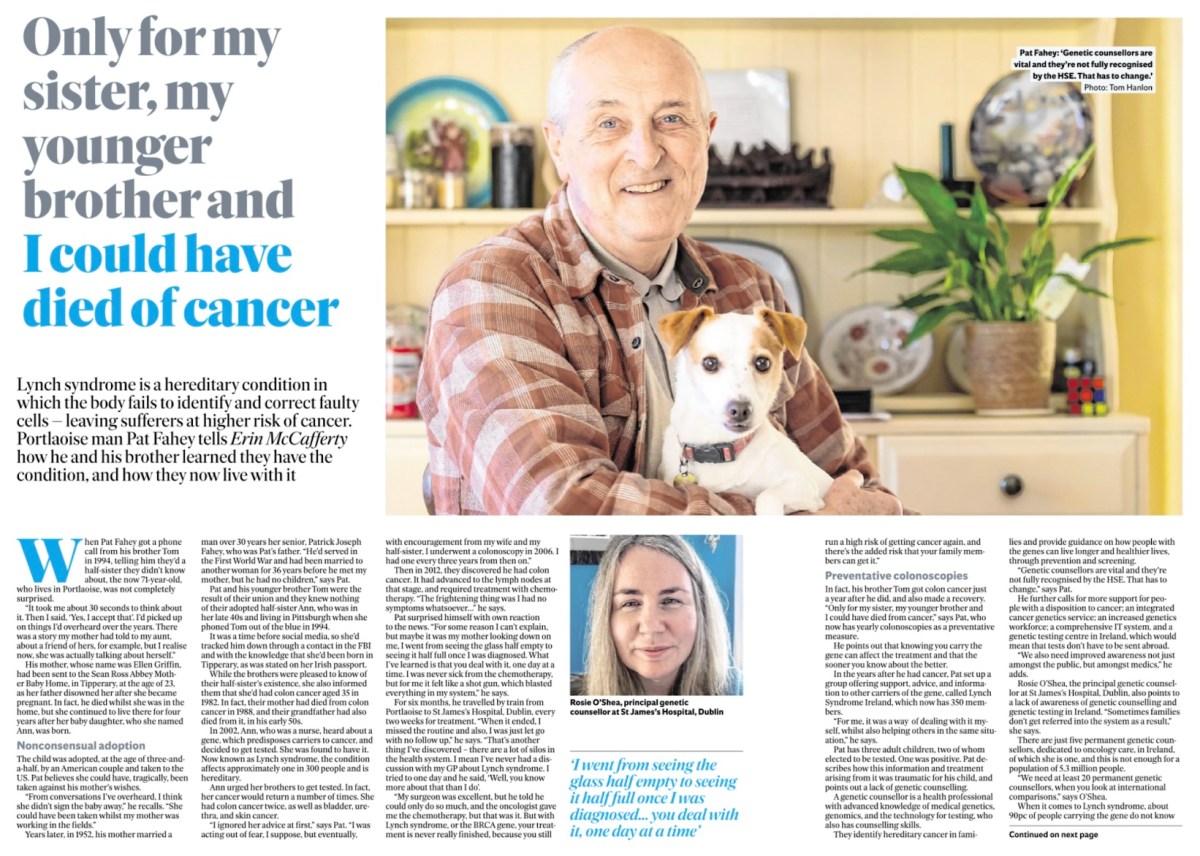
https://www.independent.ie/life/health-wellbeing/health-features/cancer-in-the-family-our-sister-was-adopted-to-america-if-we-hadnt-found-her-my-brother-and-i-could-have-died-of-cancer/a680132515.html

Cancer in the Family

If Lynch syndrome runs in your family you really need to know.

https://www.independent.ie/life/health-wellbeing/health-features/cancer-in-the-family-our-sister-was-adopted-to-america-if-we-hadnt-found-her-my-brother-and-i-could-have-died-of-cancer/a680132515.html

“Much of our work around Lynch syndrome is preventing cancer before it starts”

No other landscape in medicine has changed as drastically as the field of Clinical Genetics – Is Ireland behind the curve?

Advances in technology have been a major driver of the explosion of knowledge in genetics, now allowing us to sequence the entire human genome in a short period of time and at a fraction of the cost of previous years.

This has led to a better understanding of the natural history of cancer, the ability to assess genetic risk for cancer across populations, the development of clinical management strategies to reduce cancer risk, the development of novel therapeutic agents which target genetic alterations, and to improved education of patients and providers about genetic risk.

Hereditary cancer is hard enough to navigate, so we are thankful for patient-friendly information to help inform the decision-making process.

https://www.stjames.ie/cancer/yourtreatmentandcare/servicesandtreatments/cancergeneticsservice/

Genetic testing is a vital tool in enabling individuals to be proactive in their health care to achieve the best possible outcomes.

It’s very important for everyone to understand their cancer risks based on their personal or family history since their personal risk level may necessitate earlier, more frequent, and/or more intensive cancer surveillance.

This is the best way to ensure that you are doing everything you can to prevent cancer or catch it early when treatment has the best outcome.

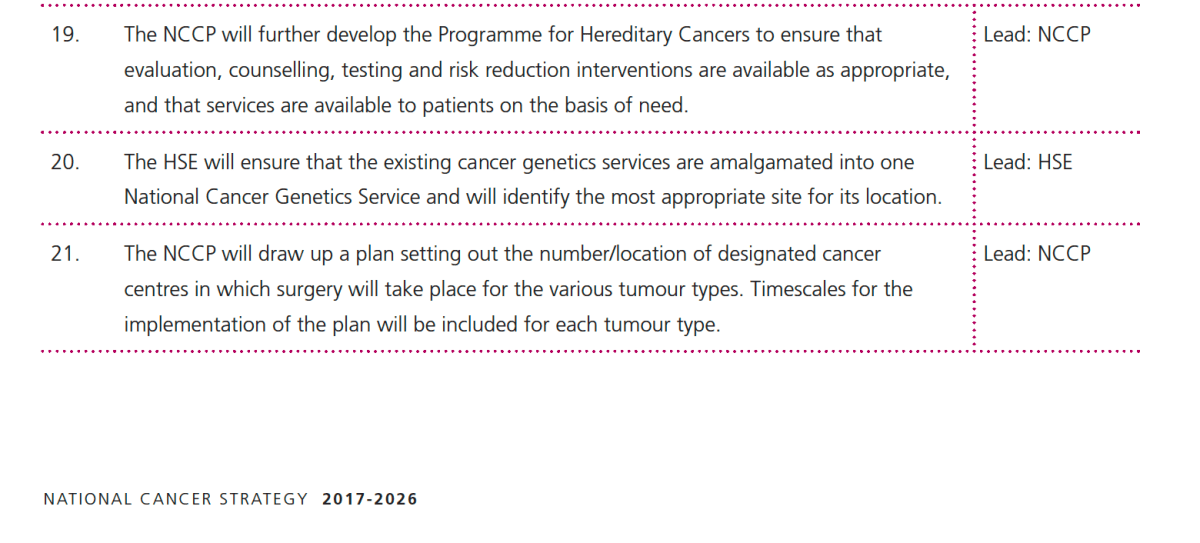
At present cancer genetics services in Ireland are underdeveloped and underfunded. Only a fraction of staff required are in place. As a result long waiting times, extra cost to the state because cancers are not prevented and discovered at a later stage.

Impact of population screening for Lynch syndrome insights from the All of Us data

Data used from the All of Us (AOU) Research Initiative to assess the prevalence of LS in the general U.S. population, and analyzed demographic, personal, and family cancer history, stratified by LS genotype to compare LS and non-LS carriers. 

The results suggest that population-based germline testing for LS may identify up to 63.2% of carriers who might remain undetected due to lack of personal or family cancer history.

Their analysis on family history of cancer indicates that cancer risk further escalates for LS carriers who also have a family history of cancer.

LS affects about 1 in 354 individuals in this U.S. cohort, where pathogenic variants in the genes MSH6 and PMS2 account for the majority of cases.

https://www.nature.com/articles/s41467-024-52562-5?fbclid=IwY2xjawH29mVleHRuA2FlbQIxMQABHczHv3SqDUHGSxdh4H1ZTHvIdPioVO4Um3gsaRLm6ukCAeL1it6PBYGPrQ_aem_TV1obtvA3TEZmXYAV3j5uw

Cancer and Fatigue Go Together

Every cancer has different side effects depending on the type, which stage it is in, and the treatments given. But when 80/100% of the people report fatigue, we know this is an ongoing problem.

I hope I continue to find new research and training on this often overlooked and important side effect – perhaps the most devastating of all!

https://www.curetoday.com/view/cancer-and-fatigue-go-together