Colonoscopies – Why bother?

It just might save your life.

During my third colonoscopy colon cancer was discovered and it had advanced to my Lymph Nodes. I had no symptoms.

Why was I having colonoscopies? I had a family history of colon cancer and my sibling had tested positive for Lynch syndrome (an inherited predisposition to certain types of cancers including colon and endometrial.

I can understand why many people are nervous about getting colonoscopies. Some wonder how long a colonoscopy will take, how best to prepare for the procedure, how much time you’ll need to take off from work and how embarrassing or disruptive this important cancer screening procedure will be.

Why should people get colon cancer screenings?

The answer is simple: colon cancer screenings can detect colorectal cancer early and prevent unnecessary deaths. Colorectal cancers also are highly preventable and treatable if detected early. In fact, if doctors detect pre-cancerous polyps during a colonoscopy, they can remove the polyps during the procedure.

Prior to Colonoscopy:

Some may think…it’s not pleasant(although having had more than 15 to date I can say I do not find it so, but including the preparation, in most cases you’re spending less than 24 hours to help prevent cancer

Typically, people prepare for a colonoscopy in their homes the day or the night before along with amending their diet for a few days prior to the procedure. The Bowel preparation prescribed — which involves drinking a lot of water along with prep – can take a number of hours . That’s because you’ll be peeing and pooping out all the waste from your body, so you’ll have a clean, empty colon.

Colonoscopy Procedure:

The actual procedure is quick – usually less than 30 minutes. The doctor inserts a scope into your rectum. You are fully sedated prior to the start of the procedure and you wake up after it is over and you usually don’t remember any of the procedure. For nearly everyone, the actual colonoscopy is painless and relatively quick. You wake up, and you’re done. Aside from not being able to drive themselves home from the procedure, most people feel well and are able to eat and drink normally after a colonoscopy.

What are polyps and how common are they?

Polyps are like skin tags that form on the lining of the colon. Some of them are pre-cancerous, which means that over a period of time, they could become cancerous. So, when polyps are found during a colonoscopy, they can easily remove the vast majority of them. That’s how colon cancer is prevented through colonoscopy.”

https://www2.hse.ie/conditions/bowel-screening/colonoscopy-after-bowel-screening/

Primary Care Research into Cancer(PRICAN)

What is PRICAN?

Cancer represents a significant public health challenge in Ireland. Forecasts also indicate a potential doubling of cancer diagnoses between 2010 and 2040, primarily due to an ageing population. 

In recent years, there has been a shift in cancer control strategies towards prioritising prevention and early diagnosis, as the most cost-effective long-term approach to cancer control.

The National Cancer Strategy explicitly calls for an expanded role for general practitioners (GPs) in managing the entire cancer continuum, from prevention and early diagnosis to treatment and ongoing survivor support.

Despite its increasing importance in cancer control, primary care research has historically received less funding compared to laboratory and hospital-based research.

Whilst screening enables early detection of some presymptomatic cancer, approximately 85% of cancers are diagnosed after the onset of symptoms . This fact underscores the importance of equipping primary care with robust clinical guidelines and efficient referral pathways. 

The anticipated rise in cancer incidence demands proactive measures to strengthen the Irish healthcare system. By recognising the critical role of primary care across the cancer care continuum, and adopting a strategic approach to investment in research, Ireland can develop and implement evidence-based policies and strategies. This approach will not only mitigate the impacts of increasing cancer incidence but also position Ireland at the forefront of innovative and effective cancer care.

https://prican.eu

Know your family history

Many men with cancer in the family worry that they are at greater risk of getting it themselves. But this isn’t the case for most people. Cancer is a common disease among older people, so most families will include at least one person who has had cancer.

The more relatives who have had cancer, and the younger they were at diagnosis, the stronger your family history. You may have a strong family history if any of these situations apply to you:

  • More than two close relatives on the same side of your family have had cancer.
  • The cancers developed when they were young (under the age of 50).
  • One of your relatives has had a gene fault found by genetic tests.

5 – 10% of cancers are linked to an inherited gene fault.

What should I do if I have a family history of cancer?

Talk to your doctor who can help you find out if your family history of cancer is of concern. Your doctor may suggest that you visit regularly for screening. In this way, you can pick up problems early.  

https://www.independent.ie/life/health-wellbeing/health-features/cancer-in-the-family-our-sister-was-adopted-to-america-if-we-hadnt-found-her-my-brother-and-i-could-have-died-of-cancer/a680132515.html

No other landscape in medicine has changed as drastically as the field of Clinical Genetics – Is Ireland behind the curve?

Advances in technology have been a major driver of the explosion of knowledge in genetics, now allowing us to sequence the entire human genome in a short period of time and at a fraction of the cost of previous years.

This has led to a better understanding of the natural history of cancer, the ability to assess genetic risk for cancer across populations, the development of clinical management strategies to reduce cancer risk, the development of novel therapeutic agents which target genetic alterations, and to improved education of patients and providers about genetic risk.

Hereditary cancer is hard enough to navigate, so we are thankful for patient-friendly information to help inform the decision-making process.

https://www.stjames.ie/cancer/yourtreatmentandcare/servicesandtreatments/cancergeneticsservice/

Genetic testing is a vital tool in enabling individuals to be proactive in their health care to achieve the best possible outcomes.

It’s very important for everyone to understand their cancer risks based on their personal or family history since their personal risk level may necessitate earlier, more frequent, and/or more intensive cancer surveillance.

This is the best way to ensure that you are doing everything you can to prevent cancer or catch it early when treatment has the best outcome.

At present cancer genetics services in Ireland are underdeveloped and underfunded. Only a fraction of staff required are in place. As a result long waiting times, extra cost to the state because cancers are not prevented and discovered at a later stage.

If I have Lynch syndrome, will I get cancer?

Not everyone with Lynch syndrome will develop cancer, but you have an increased risk compared to the general population. People with Lynch syndrome have an increased risk of developing some types of cancer, such as:

• bowel (colorectal)

• endometrial or uterine

• ovarian cancer.

Lynch syndrome causes 1 in every 35 cases of bowel cancer, 1 in every 50 cases of endometrial cancer.

Your risk of developing cancer depends on which gene is affected, your age and being male or female.

Check out http://www.plsd.eu

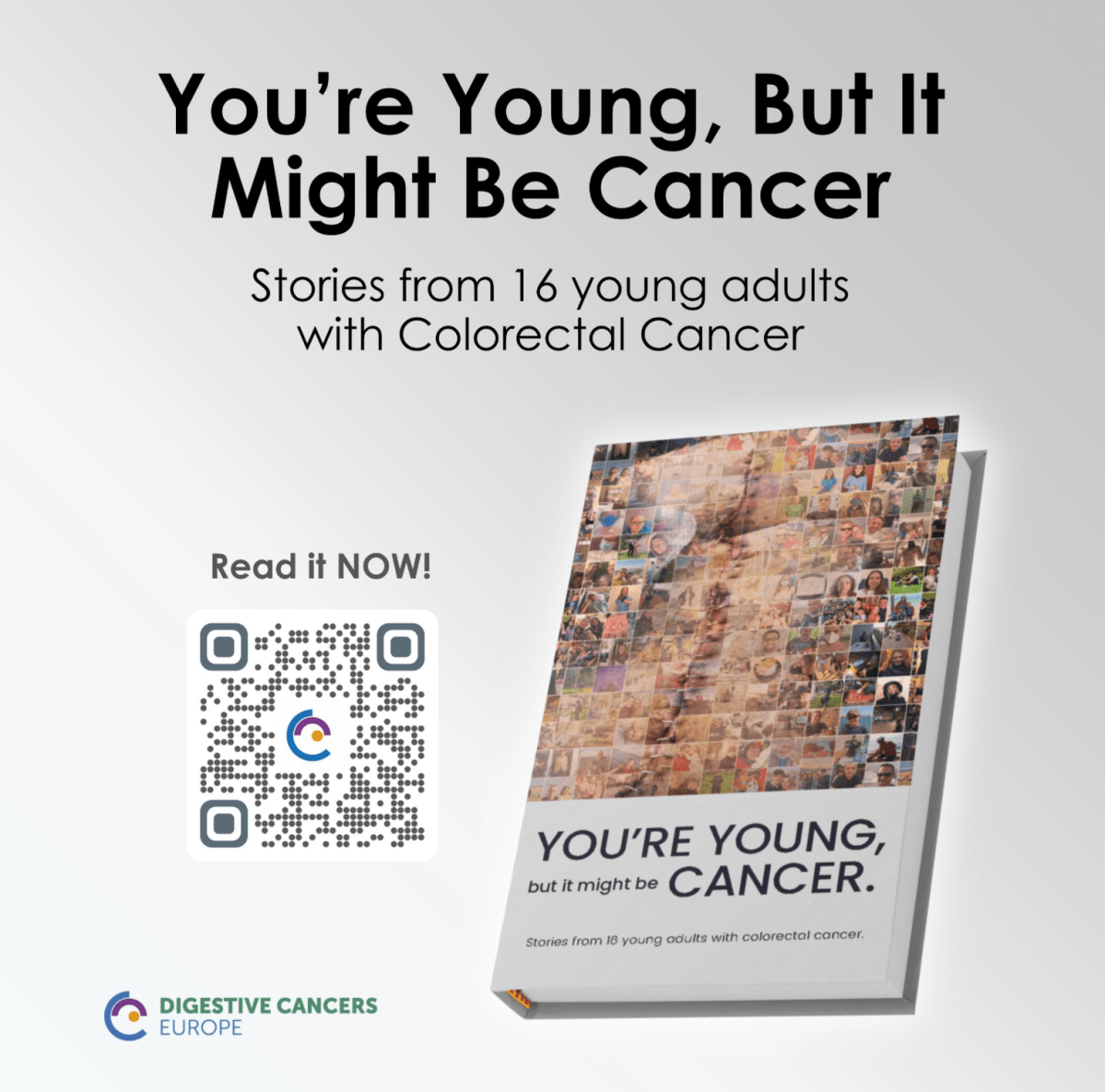
You’re Young, But It Might Be Cancer

At Digestive Cancers Europe(DiCE), they firmly believe that supporting early detection is essential for better outcomes and improving the quality of life for every patient.

By reading “You’re Young, But It Might Be Cancer,” you will gain valuable insights and perspectives from these brave survivors and contribute to DiCE’s efforts in raising awareness and empowering patients and their families.

https://digestivecancers.eu/youre-young-but-it-might-be-cancer/

‘Some good friends disappeared from my life’

What I really didn’t expect was some good friends of many years who I had spent a lot of time with simply disappeared out of my life. Some people said, “they obviously weren’t real friends” and initially I agreed, but I now try and be a bit more charitable. I think they probably couldn’t deal with the thought of someone they knew so well having a life-threatening disease or didn’t know what to say.

Tony, 63 was diagnosed with stage 3 colon cancer following a colonoscopy in late 2021, and had surgery and six months of chemotherapy.

He is aiming for a 50-mile run/walk competition in the Lake District in July 2024.

https://www.mission-remission.com/runningforrecovery

Genotes – a ‘just-in-time’ genomics education resource co-designed with clinicians

Have you heard about #GeNotes? Flagship resource of NHSE

designed to support clinicians in requesting and managing complex genomic tests – read all about it!

Powerful new genomic technologies are transforming the way healthcare is delivered, shaping medical practice across all specialties. In this rapidly changing landscape, there is an urgent need to equip the clinical workforce with knowledge and skills to navigate the new healthcare terrain.

They describe the co-design and co-creation of the GeNotes genomic education resource by clinicians, for clinicians. We anticipate that this approach will have relevance and utility for other educators attempting to meet the needs of a diverse set of end-users in similarly fast-moving fields.

https://link.springer.com/article/10.1186/s12909-024-06059-w

Steering the Treatment of Gynecologic Cancers With Biomarkers

Over the past 10 years, PARP inhibitors, immunotherapy and antibody drug conjugates have changed the treatment landscape of gynaecologic cancers, providing options for patients beyond chemotherapy.

Most of the recent FDA approvals for treating patients with gynaecologic malignancies are based on biomarkers. In ovarian cancer, germline genetic testing (patient’s blood or saliva) or somatic profiling (next-generation sequencing of a patient’s tumor) can focus on several biomarkers. For example, it can identify BRCA and homologous recombination deficiency — which occurs in approximately 50% of patients with ovarian cancers and can be treated with PARP inhibitors — and Lynch syndrome, which is a mismatch repair deficiency.

https://www.curetoday.com/view/steering-the-treatment-of-gynecologic-cancers-with-biomarkers

In an Ideal World: We would have….

  • A central point to support people who are affected by Lynch Syndrome or other Genetic Cancer defects.
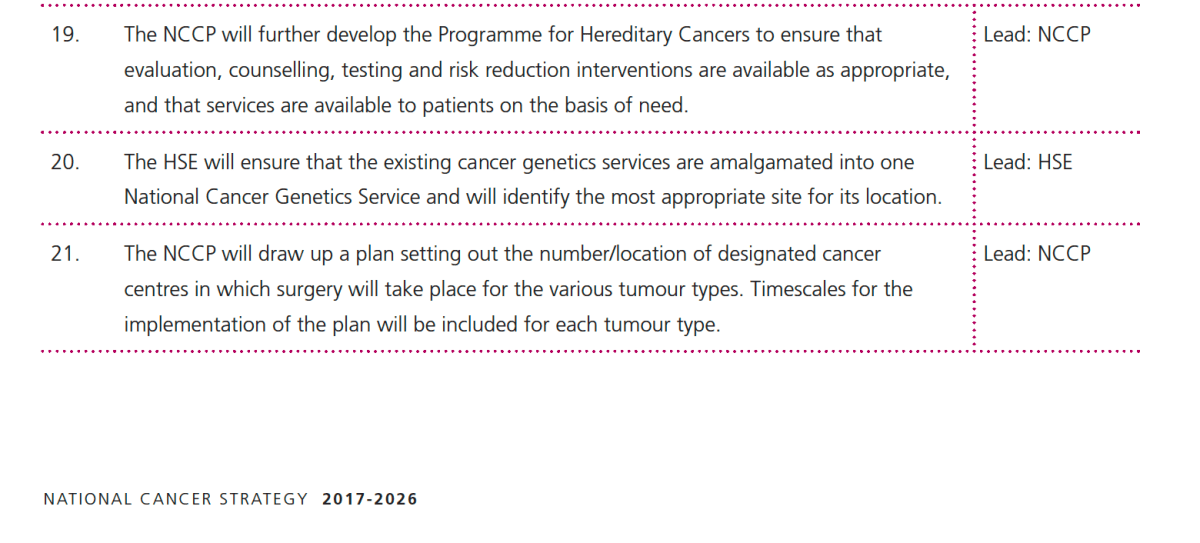
  • An integrated Cancer Genetics service.
  • An increased Genetics workforce.
  • A Genetics Testing center in Ireland.
  • A comprehensive IT system to Manage/Track and generally improve the collection/storage of relevant information.
  • Improved awareness by Public and Medics of Genetics.
  • A dedicated Pathway for people with a genetic cancer issue.
  • Improved support available to help in relaying a diagnosis to the wider family.
  • A national BioBank to improve/help research in this area.