
Blog
Supporting patient pathway though gynaecological cancer

Women themselves may be unaware of the sometimes symptoms or may be too embarrassed to consult a doctor, and there remains a stigma associated with these diagnoses in some quarters. This reticence needs to be overcome and a more positive message developed to improve the prevention, screening, treatment and care of gynaecological cancers so that women throughout Europe have the best chance of survival and quality of life.
Ovarian, uterine, cervix and other gynaecological cancers are among the most common cancers to affect women, but collectively attract less attention than they deserve from the public and policy makers.
WHAT SHOULD YOU ASK THE DOCTOR?
Useful information before, during, and after your meeting with your doctor(s)
Brochure from ENGAGe (The European Network of Gynaecological Cancer Advocacy Groups is an ESGO network of European patient advocacy groups representing all gynaecological cancers)
https://engage.esgo.org/brochures/what-should-you-ask-the-doctor/
Uptake and patient-related outcomes of mainstreaming genetic testing: a systematic review and meta-analysis

Mainstreaming genetic testing refers to genetic testing for cancer susceptibility genes following cancer diagnosis, which is provided by nongenetic health professionals of the cancer-treating team.
Mainstreaming can be used to guide cancer treatment and secondary cancer prevention in the patient and to identify carriers in the family members of patients who test positive through cascade testing. We aimed to assess uptake and patient-reported outcomes of mainstreaming genetic testing.
Conclusion
Mainstreaming genetic testing uptake is associated with high uptake and satisfaction and low decision conflict, regret, and post-test distress. Quality and quantity of evidence across different types of cancers vary significantly.
In Our Scope of Practice: Genetic Risk Assessment and Testing for GI Cancers and Polyposis in Gastroenterology
Uptake of genetic testing remains underutilised.
This is a missed opportunity to identify patients and family members who could benefit from genetic testing to diagnose cancer susceptibility syndromes for which surveillance and preventive interventions exist.
Barriers for integration of genetic testing in routine practice include:
–lack of awareness about genetic conditions by patients and providers,
–concerns about genetic testing costs and implications for insurability,
–challenges in implementing algorithms for risk assessment and coordinated care in complex medical systems.
This review addresses current evidence and guidelines for cancer risk assessment, genetic testing and management to enable GI clinicians to identify and care for individuals with genetic cancer-predisposition syndromes in routine practice.
https://www.gastrojournal.org/article/S0016-5085%2825%2900841-8/abstract
Tackling the Impact of Cancer on Health, the Economy and Society: Ireland
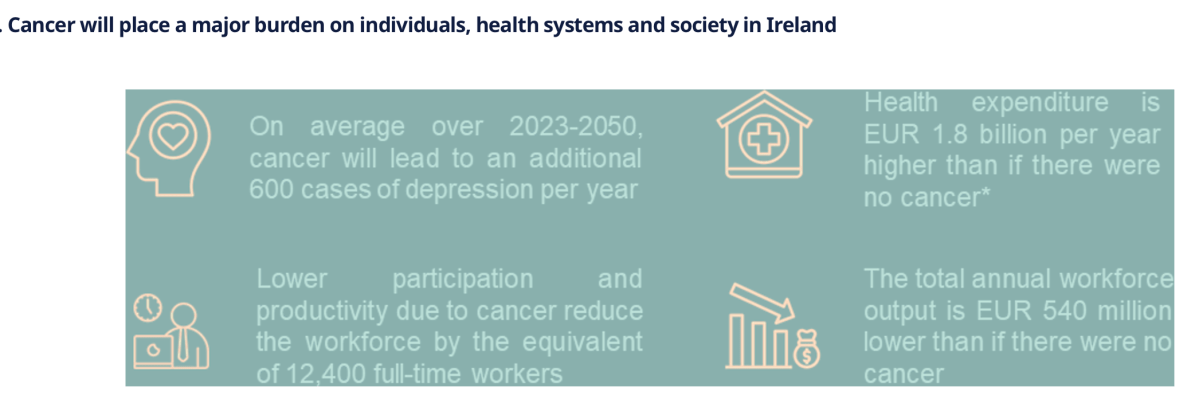
Despite advances, cancer remains a significant public health challenge in Ireland
Despite advances, cancer remains a significant public health challenge in Ireland.
Cancer is the leading cause of mortality in Ireland, and one in three premature (before the age of 75) deaths (30%) will be due to cancer between 2023 and 2050.
In total, there will be an estimated 3 500 premature deaths from cancer every year, and the average population life expectancy will be 2.1 years lower than if there were no cancer.
Tackling the Impact of Cancer on Health, the Economy and Society: Ireland
Action on key cancer risk factors would reap a wide range of benefits
Meeting international policy targets on major cancer risk factors would prevent around 10% of all cancer cases, avert 16% of premature deaths due to cancer, and reduce the burden of cancer on health expenditure by 12% in Ireland.
Access to oncology medicines in EU and OECD countries

Ensuring equal access to the latest cancer medicines is one of the most pressing challenges facing OECD health systems today.
Despite the emergence of new oncology drugs, disparities in patient access—particularly through clinical trials and early access programs—remain a critical issue.
Rising costs are also straining even the most affluent healthcare systems, making affordability a concern for all.
This working paper examines various aspects of inequalities in access to cancer medicines, covering key stages in a medicine’s life cycle, from marketing authorisation to reimbursement decisions and uptake in clinical practice.
The analysis draws on original findings from the 2023 OECD Policy Survey on Cancer Care Performance. It also explores potential strategies to stimulate competition among oncology medicine producers, which could create significant budget headroom, allowing reinvestment in new cancer medicines that offer substantial clinical benefits to patients.
National Cancer Registry Ireland

NCRI collects information on the diagnosis and primary treatment of the patient’s cancer. Data is collected on primary treatments that take place within approximately 12 months of diagnosis.
Between 85% and 90% of all new tumour registrations are registered electronically from pathology reports shortly after the patient’s diagnosis. Other electronic data sources such as HIPE(collects demographic, clinical and administrative data on discharges from, and deaths in, acute public hospitals nationally), radiotherapy and death certificates may also create a small number of new tumour registrations.
One of the primary ways to share NCRI data is through reports and publications. These reports compile the latest statistics and analyses, and highlight many topics including:
- emerging cancer trends
- the effectiveness of prevention and treatment initiatives
- cancer disparities
- areas where prevention efforts are needed
These reports provide stakeholders with the necessary insights to guide decision-making.
https://www.ncri.ie/en/data-collection/the-data-journey/the-patient
When “Look on the bright side!” feels wrong

Nobody wants to say the wrong thing to any newly-diagnosed patient, but that perky “good kind of cancer” comment can land with a hollow thud.
Yale University professor of psychology Dr. Laurie Santos calls this cheerfully minimizing response to a cancer patient as “the kind that decides ‘bad’ negative emotions could be fixed if only we had a more ‘look on the bright side!’ attitude.”
What Joe Biden’s cancer diagnosis means for the rest of us

When someone hears those words, you have cancer, her world is turned up-side-down, in more ways than one. As is her family’s. I won’t say a cancer diagnosis is necessarily the most horrible thing any person can experience, medically speaking or otherwise, but it’s right up there, that’s for sure.
Once a cancer reaches stage 4, it’s not curable. Treatable, yes. Curable, no.
This is not to say staying positive and fighting hard do not matter. Of course, they do. But cancer outcome is not determined by how hard you fight or how much smiling you do. Cancer isn’t an opponent in some war game you can stomp out with mindset or determination. And a positive attiude—not always doable. Cancer patients don’t need the added pressure to always fight and always stay positive. What does that even mean anyway? It sounds exhausting because it is.
Recent Advances in Lynch Syndrome Diagnosis, Treatment and Cancer Prevention

Conclusion:
The identification and management of individuals and families with Lynch syndrome has evolved rapidly during the past decade or so. Advances in molecular testing and NGS technologies now allow all patients with colorectal and endometrial cancers to reliably receive screening for underlying Lynch syndrome, whereas innovations in immuno-oncology promise to continue revolutionising the treatment of Lynch-associated cancers.
To continue moving the needle forward, expanded efforts to diagnose Lynch syndrome in healthy, cancer-free individuals are needed, rather than relying on the identification of Lynch syndrome through a new cancer diagnosis.
Identification of Lynch syndrome offers the potential to prevent cancer-related morbidity and mortality, and continued progress in understanding the immune system’s ability to recognize, eradicate, and intercept Lynch-associated neoplasia offers many intriguing possibilities for immune-based primary cancer prevention.

